Bacillus
These rod-shaped soil bacteria produce natural antibiotic compounds — lipopeptides — that punch holes in fungal cell membranes and prime your plants' immune systems. They are your garden's chemical defence force, sprayed onto leaves to protect against disease.
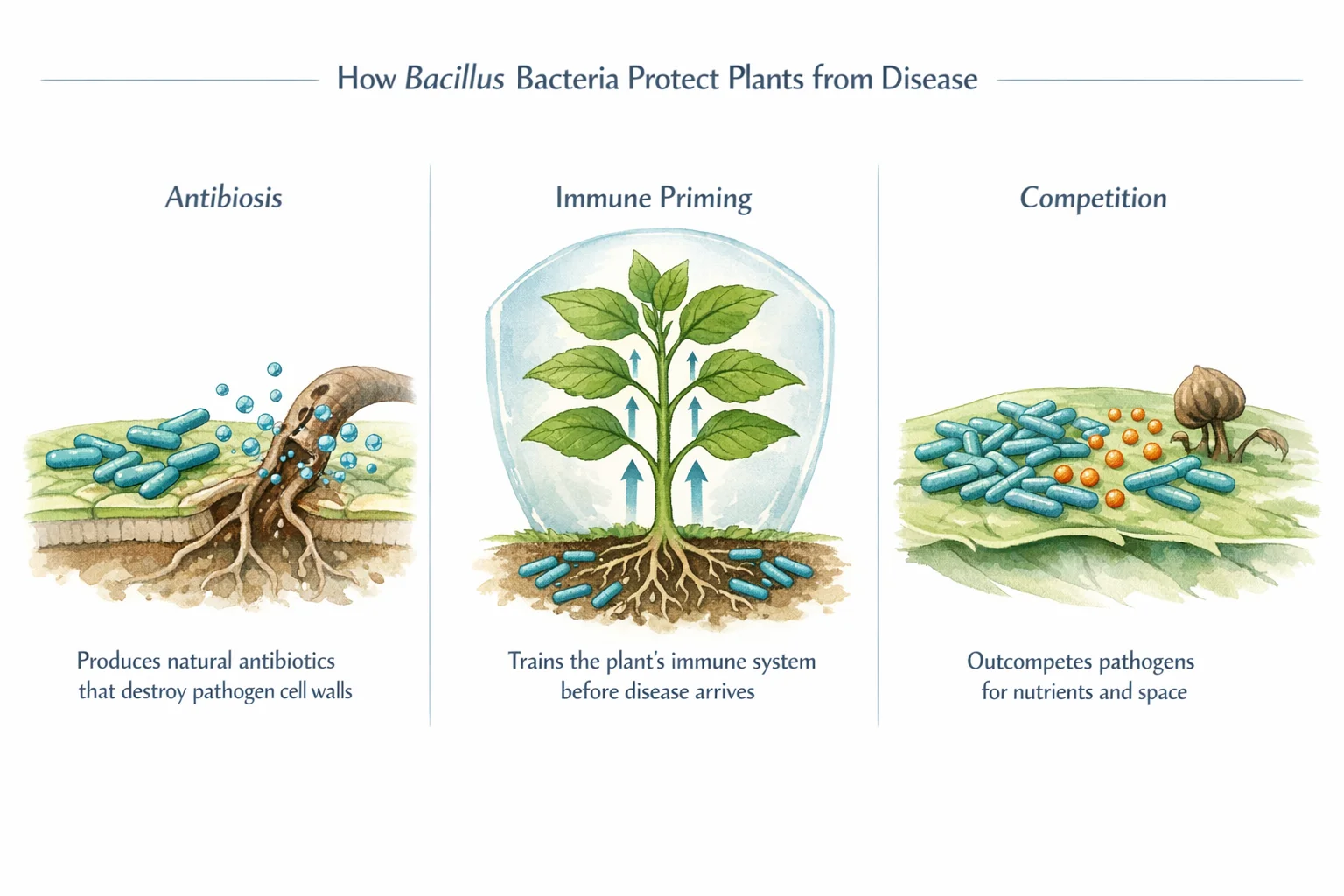
A — How Bacillus Protects Your Plants
Unlike Trichoderma fungi which colonise roots and stay for longer in the root zone, Bacillus disease products are most often used as foliar sprays on leaves and fruit. On the plant surface they do not persist as long, so repeat applications are usually needed while disease pressure is active.
Lipopeptide Antibiotics
Bacillus produces natural antibiotic compounds — iturin, fengycin, and surfactin — that punch holes in fungal cell membranes, causing them to burst. Think of it as a microscopic pressure washer for pathogens. These compounds have been extensively characterised in the QST 713 strain (Pandin et al. 2018).
Immune Priming
When Bacillus touches a leaf, it wakes up the plant's own immune system — like a vaccination. The plant switches on its defences before a pathogen arrives. Scientists call this Induced Systemic Resistance (ISR). Lahlali et al. (2013) measured defence genes running 2–23× higher than normal after Bacillus treatment.
Competition
Bacillus jams the communication signals that pathogens use to coordinate attacks — a trick called quorum quenching. It also physically crowds out pathogens by occupying leaf and root surfaces first, hogging the nutrients and attachment sites that fungi and bacteria need to gain a foothold.
Dual mechanism confirmed. The lipopeptide antibiotics are not the whole story. Lahlali et al. (2013) showed that the whole Bacillus product suppressed clubroot by >90%, while the filtrate or cells alone only achieved 62–83%. The combination of direct antibiosis plus ISR is greater than either mechanism alone.
B — What's Actually Available to Home Gardeners
We apply the same selection criteria across all our biocontrol guides — Trichoderma, Bacillus, and Beauveria — for Olier's recommendation engine:
We also prefer strains backed by independent, peer-reviewed field studies — though we recognise that EPA/EU registration itself requires efficacy data, even when that data is proprietary. Where a product meets the three criteria above but lacks published independent research, we say so clearly.
Foliar Disease Spray
For powdery mildew, leaf spots, grey mould, and bacterial diseases on leaves and fruit.
Cease
BioWorks / BiobestQST 713 is one of the best-documented consumer Bacillus strains. It is the same strain historically used in Serenade consumer products, and it remains widely cited in Bacillus biocontrol research. EFSA reviewed a large QST 713 literature set in 2021, and Pandin et al. (2018) published the complete genome and confirmed the strain's current taxonomy as B. velezensis.
Foliar Spray + Soil Drench
For both leaf diseases and soilborne pathogens. D747 has the broadest EPA label of any Bacillus biofungicide — including soil drench application.
Monterey Complete Disease Control
Lawn & Garden ProductsD747 is a separate strain from QST 713 and appears in several US garden products, including Monterey Complete and Bonide Revitalize. On this page, its clearest cited strength is white mould control in beans, while several of its other uses rely more on registration documents and extension trials than on easy-to-audit consumer field papers.
Bonide Revitalize
Bonide ProductsSame D747 strain as Monterey Complete, manufactured under Certis licence. Available in concentrate and ready-to-use formats. Same EPA registration, same evidence base.
Arber Organic Fungicide
Arber (ProFarm Group)A newer direct-to-consumer brand using strain F727. Also registered as Stargus (professional). Attractive consumer packaging and marketing, available in ready-to-spray format. F727 is a separate strain from both QST 713 and D747. Registered for broad-spectrum foliar disease control.
Transparency note. No peer-reviewed field efficacy studies on F727 have been published. EPA registration requires efficacy data submission, but that data is proprietary. We include Arber because it meets our three criteria (named strain + EPA registered + consumer-purchasable), but the evidence tier is regulatory-only.
Companion
Growth ProductsEPA-registered product based on one of the best-known biocontrol strains in the literature. GB03 has genuine biocontrol and growth-promotion research behind it, including a distinctive volatile-mediated ISR story: it releases 2,3-butanediol and acetoin into the air, triggering systemic resistance without direct contact in the Ryu et al. (2004) system. In practice, the retail Companion product reads more like a fertiliser-plus-microbial product than a clean, field-validated biofungicide story.
Honest caveat. The strongest GB03 papers are usually about the strain itself under research conditions, not the retail Companion product in a home-garden program. That makes Companion more speculative than Cease or Monterey from an evidence point of view. We include it because the strain is real and the product is registered, but the product-level field validation is thinner.
Which diseases do they target?
| Disease | Pathogen | Product | Evidence |
|---|---|---|---|
| Powdery mildew | Erysiphe, Podosphaera spp. | Cease (QST 713), Monterey (D747) | Field (20–65%) |
| White mould | Sclerotinia sclerotiorum | Monterey (D747) | Field (70–98%) |
| Bacterial spot | Xanthomonas spp. | Cease (QST 713) | Field (43.7%) |
| Bacterial speck | Pseudomonas syringae | Monterey (D747) | Extension trial |
| Damping-off | Pythium, Rhizoctonia | Monterey (D747) | Field |
| Root rot | Rhizoctonia solani | Monterey (D747) | Field |
| Bacterial canker | Pseudomonas syringae pv. actinidiae | Monterey (D747) | Field (40–70%) |
| Gummy stem blight | Didymella bryoniae | Cease (QST 713) | Greenhouse (~55%) |
| Grey mould | Botrytis cinerea | Cease (QST 713) | Greenhouse study + label support |
| Rust | Puccinia spp., Uromyces spp. | Cease (QST 713) | EPA label only |
| Downy mildew | Peronospora spp., Plasmopara viticola | Cease (QST 713) | EPA label only |
| Fire blight | Erwinia amylovora | Cease (QST 713) | Inconsistent (9–36%) |
| Fusarium wilt | Fusarium oxysporum | Monterey (D747) | EPA label only |
| Verticillium wilt | Verticillium dahliae | Monterey (D747) | EPA label only |
How to read this table
Disease-specific notes
- Grey mould
- Supported here by greenhouse data plus registration documents. We are not treating it as the same evidence tier as an open-field crop trial.
- Fire blight
- Dimmed due to inconsistent field results — only 9–36% reduction across trials (Aldrich et al. 2009). EPA-registered but not reliably effective.
- Rust & Downy mildew
- Listed on the QST 713 EPA label (PC Code 006479), but published consumer-crop trials are lacking.
- Fusarium & Verticillium wilt
- Appear on the D747 EPA soil-drench label. No peer-reviewed trial confirms these claims.
C — What the Research Shows
We evaluate each strain individually. EPA and EFSA registration means government scientists reviewed proprietary safety and efficacy data — but we also look at what independent researchers have published.
B. velezensis QST 713 Cease
43.7% bacterial spot reduction (tomato)
4-year field trial in Ontario, Canada. Tank mix with copper hydroxide provided additive effects (Leblanc et al. 2015).
20–65% powdery mildew reduction (cereals)
Multi-site trials across winter wheat, spring barley, oats, and triticale. Variable but statistically significant (Matzen et al. 2019).
Helpful in fire blight program
Multi-state fire blight work supports Bacillus products as one part of integrated non-antibiotic programs, but the published material we harvested shows variable Serenade performance rather than a simple stand-alone replacement for antibiotics (DuPont / WSU fire blight program material).
>90% clubroot suppression
Controlled environment — dual mechanism confirmed: direct antibiosis plus ISR. Defence genes upregulated 2.2–23× (Lahlali et al. 2013).
~55% gummy stem blight reduction
Four cucumber diseases tested. Preventative application 24h pre-inoculation required — no eradicative effect (Punja et al. 2019).
Where it struggles. Fire blight control was inconsistent — a 6-year, 3-state trial (Aldrich et al. 2009) showed only 9–36% reduction. Biologicals alone were not consistently effective for fire blight. Dollar spot on turf was also poorly controlled (Koch et al. 2021). Bacillus is not a substitute for antibiotics on fire blight or chemical fungicides on turfgrass.
B. amyloliquefaciens D747 Monterey / Bonide / Double Nickel
70–98% white mould reduction (beans)
3-year, 5-trial evaluation on snap and dry beans in New York. Comparable to conventional fungicide (boscalid). The strongest published result for any Bacillus biofungicide (Pethybridge et al. 2019).
Rhizoctonia damping-off reduced
In-furrow application at seeding significantly reduced Rhizoctonia damping-off at emergence in snap beans (Pethybridge et al. 2024).
Pumpkin powdery mildew — matched conventional
D747/Cueva organic program had comparable yields to conventional fungicide, with no significant difference in diseased foliage (Mississippi State Extension).
Tomato bacterial spot — as effective as copper
1–2 years of Cornell extension data showed Double Nickel comparable to copper for bacterial spot and bacterial speck on tomato.
Lab-to-field gap documented. Rebollar-Alviter et al. (2023) showed D747 significantly reduced Sclerotinia stem rot in growth chamber trials, but field-grown soybeans showed no significant yield benefit. This is a recurring theme with Bacillus biocontrols — lab efficacy does not always translate to field results. The strongest evidence comes from crops where disease pressure is high and consistent (beans, greenhouse cucumbers), not broadacre crops.
B. velezensis GB03 Companion
Unique VOC-ISR mechanism
GB03 produces volatile 2,3-butanediol and acetoin that trigger ISR through the air in sealed systems (Ryu et al. 2004). Confirmed as soil drench in field conditions (pepper, cucumber). Whether Companion's low concentration achieves this is untested.
Field story still needs a cleaner primary source
We found a Morocco fire blight conference trail connected to Ait Bahadou, but not a clean product-level field paper that supports the stronger GB03 numbers previously used on this page. For now, treat Companion as an interesting strain-led product with thinner direct field evidence.
D — The Taxonomy Story (It's Complicated)
If you read the labels carefully, you'll notice different products claim different species names for what turns out to be closely related — or even the same — organisms. This is because Bacillus taxonomy has been revised multiple times:
| Strain | Original label name | Current name (genome) | Note |
|---|---|---|---|
| QST 713 | B. subtilis | B. velezensis | Reclassified twice: subtilis → amyloliquefaciens → velezensis. Complete genome published 2018 (Pandin et al.). |
| D747 | B. amyloliquefaciens | B. amyloliquefaciens | Name stable so far, but the amyloliquefaciens/velezensis boundary is still debated. |
| GB03 | B. subtilis | B. velezensis | Same reclassification as QST 713. Label still says subtilis. |
| F727 | B. amyloliquefaciens | B. amyloliquefaciens | Strain-specific data limited. |
The practical implication: don't choose products by species name. B. subtilis, B. amyloliquefaciens, and B. velezensis are used almost interchangeably on labels and in older literature. What matters is the strain (QST 713, D747, etc.) — that's the level at which efficacy data exists.
E — Using Bacillus in Your Garden
Apply preventatively
Bacillus works best before disease arrives. Punja et al. (2019) showed 55% gummy stem blight reduction when applied 24h before inoculation — but zero eradicative effect on established infections. Start spraying early in the season.
Reapply as needed
On leaves, Bacillus does not persist as long as root-colonising fungi. Rain, sunlight, and new plant growth all reduce coverage, so repeat sprays are usually needed while disease pressure is active. Follow the product label for timing.
Bacillus + Trichoderma can be complementary
Many growers use Trichoderma in the root zone and Bacillus on leaves, which is a practical way to give each tool a different job. The clearest paper cited here is narrower than a universal garden rule: in grapevine, a Bacillus + Trichoderma combination helped in one cultivar but not another (Leal et al. 2021). So the pairing is promising, but not equally proven in every crop.
Set realistic expectations
Results on this page range from moderate suppression to very strong control in some trials, but performance varies a lot by crop, pathogen, and conditions. Bacillus tends to look best where disease pressure is steady and you can spray preventatively — vegetables, greenhouse crops, and some fruit crops.
Safe for pollinators and edible crops
Home gardeners often choose Bacillus products for edible crops because the EPA labels are generally crop-friendly and widely used around harvest periods. Treat that as label and regulatory guidance, though, not the same kind of evidence as the disease-control trials above. Always follow the specific product label you are using.
F — Full Registration Status
Every Bacillus disease-control strain we evaluated, and where it stands with regulators. Only strains with EPA or EFSA registration appear in Olier's recommendations.
| Strain | EPA (USA) | EFSA (EU) | Consumer product | Published evidence |
|---|---|---|---|---|
| QST 713 | Yes PC-006479 | Yes 2021 | Cease (US) | Large published literature + EFSA review |
| D747 | Yes PC-016482 | Yes 2014 | Monterey, Bonide, Southern Ag | Several peer-reviewed and extension sources |
| F727 | Yes | No | Arber (US) | Regulatory only |
| GB03 | Yes 71065-3 | No | Companion (US only) | Large strain literature; thin product-level evidence |
| MBI 600 | Yes | Yes | Serifel, Subtilex (pro) | Moderate (BASF data) |
| FZB42 | Yes | Yes | RhizoVital (limited) | Well-studied genome; limited field |
| FZB24 | Yes | Yes | Taegro (pro) | Moderate |
| QST 2808 (B. pumilus) | Yes | Yes | Sonata (discontinued) | Moderate — powdery mildew specialist |
Strains dimmed in the table are registered but harder to find in mainstream home-gardener channels. MBI 600, FZB42, FZB24, and QST 2808 are mainly professional or seed-treatment stories. Sonata and Serenade Garden also no longer appear to be active mainstream consumer lines.
G — Common Questions
What is the difference between Cease, Monterey Complete, and Serenade?
Cease uses strain QST 713. Monterey Complete uses a different strain, D747. Both are Bacillus disease-control products, but they are not the same thing in a different bottle. Serenade Garden also used QST 713, so it is the closest historical comparison to Cease.
Can I use Bacillus together with Trichoderma?
You can combine them, but the evidence is narrower than a blanket rule for every garden. In practice, many growers use Trichoderma in the root zone and Bacillus on leaves, which is a sensible way to keep their roles separate. The clearest paper cited here found a Bacillus + Trichoderma combination helped in one grapevine cultivar but not another (Leal et al. 2021), so think of the pairing as plausible rather than universally proven.
Is Bacillus safe for mycorrhizal fungi in my soil?
The cautious answer is: probably often yes, but not with enough clean evidence for a blanket guarantee. Some newer studies suggest certain Bacillus strains can coexist with arbuscular mycorrhizal fungi, but the outcome depends on the exact strain, fungus, crop, and application method. If you want to play it safe, use Bacillus mainly as a foliar spray and avoid repeated heavy soil drenches directly on top of a fresh mycorrhizal inoculation.
Is Bacillus subtilis the same as Bacillus thuringiensis (Bt)?
No — they are different species in the same genus, with completely different functions. Bacillus disease biocontrol bacteria (B. velezensis, B. amyloliquefaciens) protect plants from fungal and bacterial diseases. Bacillus thuringiensis (Bt) kills caterpillar and beetle larvae. They serve different purposes and are used differently. See our separate Bt guide for insect biocontrol.
Why was Serenade Garden discontinued?
The clean short answer is that Serenade Garden is no longer the easy consumer-facing QST 713 product it once was. Bayer acquired AgraQuest, the company behind QST 713, in 2012, and the home-garden Serenade line later faded from the market. For gardeners today, Cease is the clearest current point of comparison if you specifically want the QST 713 strain.
H — References
Peer-reviewed studies
Regulatory documents