Beauveria bassiana
Beauveria bassiana is best known as an insect-killing fungus. The more interesting papers go a step further: some strains also live inside plant tissues and help plants resist disease. That second job looks real, but it is strain-specific, crop-specific, and not something to assume from the species name alone.
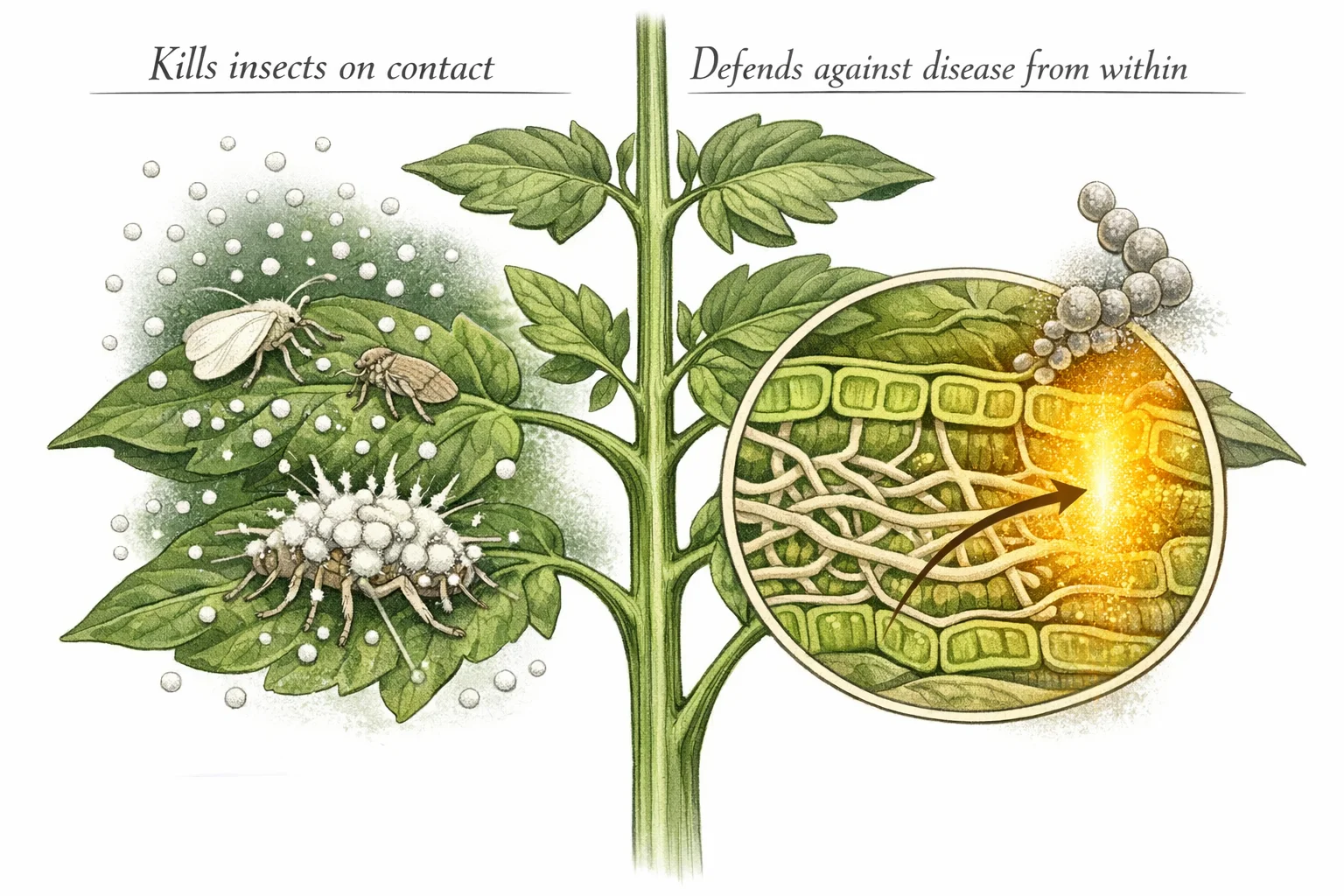
A — How Beauveria Works
Beauveria bassiana is an entomopathogenic fungus: it infects insects. In some of the papers behind this page, certain strains also established inside plant tissues as endophytes and were linked to stronger plant defence responses.
Contact Kill
Beauveria spores land on an insect's outer shell and germinate. Hyphae penetrate the cuticle, grow inside the body cavity, and eventually kill the insect. After death, the fungus can sporulate on the insect surface, which is why white muscardine disease is the classic visual sign.
Hidden Defender
In several plant studies, Beauveria behaved as an endophyte and was linked to stronger defence. With strain GHA, the clearest mechanism was salicylic acid accumulation and HR-like defence against powdery mildew. Other strains, such as ATCC 74040, showed a different defence-gene pattern.
What is genuinely interesting here. The MMD set supports a real dual-use story for some strains: insect infection on one side, plant-disease side benefits on the other. But those plant-side benefits are not universal across the species, which is why the rest of this page stays strain-first.
B — How Olier Reads a Beauveria Product
The species name alone is not enough. In the 10-isolate tomato screening paper, only four isolates showed good overall control activity across the tested biotic stressors. So when Olier recommends a Beauveria product, we prefer:
On this page, the clearest research-backed strain names are GHA, ATCC 74040, and PPRI 5339. Product names are included only where the MMD set clearly ties them to the strain.
GHA
BotaniGard in the papersThis is the best-studied dual-use strain on the page. The Iida paper tested commercial Botanigard and isolated GHA from it. In that work, Botanigard/GHA suppressed powdery mildew in cucumber, tomato, strawberry, melon, and eggplant systems, and the mechanism pointed to salicylic-acid-linked, local defence rather than whole-plant systemic protection.
ATCC 74040
Naturalis in the papersThis is the clearest strain here for grapevine endophytic work. In the papers, ATCC 74040 or the formulated product Naturalis established inside grapevine, reduced downy mildew severity, lowered grape leafhopper pressure, and in a separate orchard study reduced cherry fruit fly damage.
PPRI 5339
promising field strainThis strain looks promising for field colonisation and plant-performance effects. In Greek field work it colonised melon and strawberry, reduced aphid and thrips populations, and increased flower and fruit set. On this page, though, the disease-control story is still thinner than it is for GHA or ATCC 74040.
Why the strain name matters. If a label only says "Beauveria bassiana," this page cannot tell you whether it behaves like GHA, ATCC 74040, PPRI 5339, or some other isolate. That matters because only four of ten isolates in the tomato screening paper showed good overall control activity.
C — What the Research Shows
We keep published field results, greenhouse or lab results, and broad strain-screening results separate. This section is about what the papers show, not what a regulator or a marketplace listing might say.
B. bassiana GHA BotaniGard
Powdery mildew suppression in crop trials
The Iida paper reports Botanigard work in greenhouse and open-field vegetable systems. Cucumber, tomato, strawberry, melon, and eggplant all appear in the trial set, and the treatment suppressed economically important powdery mildews.
Salicylic acid mechanism is well supported
In cucumber and tomato work, GHA increased salicylic acid signalling, promoted HR-like cell death at penetration sites, and lost part of its effect in SA-deficient tomato plants. This is the cleanest mechanism story on the page.
The effect was local, not whole-plant systemic
That same GHA paper is helpful because it also sets a limit: powdery mildew suppression was local rather than systemic, so this is not a magic whole-plant immunity story.
Important limit. GHA has the clearest powdery mildew mechanism on this page, but that should not be read as a species-wide rule. It is one strain in one especially well-studied crop-pathogen story.
B. bassiana ATCC 74040 Naturalis
3–89% reduction in downy mildew severity
ATCC 74040 (Naturalis) colonised grapevine as an endophyte and significantly reduced Plasmopara viticola disease severity on treated leaves. Microarray and RT-qPCR analysis confirmed up-regulation of defence-related genes. Disease reduction was leaf-age dependent and did not extend to leaves that grew after treatment — no systemic effect detected (Rondot & Reineke 2019).
Endophyte persisted 5 weeks in vineyard grapevines
ATCC 74040 established endophytically in mature vineyard grapevines, while GHA was confirmed as an endophyte in potted greenhouse plants. ATCC 74040 was detected as an endophyte up to 5 weeks after last application. Significant reduction of grape leafhopper (Empoasca vitis) infestation observed in the vineyard. Endophytic B. bassiana also reduced vine mealybug (Planococcus ficus) infestation and growth in greenhouse bioassay (Rondot & Reineke 2017).
67–90% efficacy against cherry fruit fly
Two-year field trial in Italian cherry orchards. Naturalis (ATCC 74040) applied 3–5 times during flight period reduced Rhagoletis cerasi fruit damage by 67–90% depending on rate and year — comparable to or better than chemical reference (dimethoate). Suitable for organic farming (Ladurner et al. 2008).
Top-3 endophyte coloniser of tomato
In a screening of 10 B. bassiana strains, ATCC 74040 was among the top 3 for endophytic colonisation of tomato (alongside Bb716 and Bb688). Inhibited both Botrytis cinerea and Alternaria alternata in vitro plate confrontation assays, though wild strain Bb716 showed stronger growth promotion. ATCC 74040 actually scored higher on Alternaria disease control in the same screening (Sinno et al. 2021).
B. bassiana PPRI 5339
Endophytic colonisation + growth promotion in field
All 3 tested strains colonised both melon and strawberry in Greek field conditions. Decreased aphid and thrips populations. PPRI 5339 increased flower and fruit set — a growth-promotion effect not seen with GHA (Mantzoukas et al. 2022).
Promising, but still a thinner disease story
PPRI 5339 looks interesting for endophytic establishment and crop performance, but the Beauveria MMD folder does not give it the same disease-mechanism depth that GHA has or the same grapevine dataset that ATCC 74040 has.
Other Beauveria Results Worth Knowing
Potato Rhizoctonia reduction with a wild strain
Tomilova et al. found that pre-plant tuber treatment with wild strain Sar-31 lowered Rhizoctonia in stems and stolons and reduced the sclerotium index on daughter tubers. Useful as proof of concept, but not a commercial-strain result.
Botrytis resistance from endophytic blastospores
Sui et al. showed that endophytic colonisation by aerial conidia or blastospores could improve resistance to Botrytis cinerea in Arabidopsis, with blastospores looking especially promising.
Trichoderma pairing looks promising, not settled
The maize co-culture paper found promising synergy between B. bassiana and T. asperellum, including higher defence-enzyme activity. That is encouraging, but it is still one crop-specific study rather than a universal mix-and-match rule.
Only four of ten isolates looked broadly strong
The Sinno tomato screening is the best reminder not to overgeneralise from the species name: performance varied widely by isolate, even within the same host-pathogen system.
D — When and How to Use It
Give the spores a low-UV window
This is the clearest practical lesson in the literature. UV radiation is one of the most damaging environmental factors for Beauveria conidia, and oil-based formulations can protect them better than water-based sprays. Early, late, shaded, or greenhouse conditions make more sense than harsh midday sun.
Treat humidity as context, not a magic number
Moisture and temperature clearly matter for fungal performance, but the neat “25 to 30 degrees and over 80% RH” rule is stronger than this MMD set supports. One housefly bioassay points in that direction, but we treat it as a clue, not a universal garden recipe. In practice, Beauveria is usually a better fit for less harsh, less drying conditions.
Pairing with Trichoderma looks promising
The Batool maize paper found promising synergy between Beauveria and Trichoderma asperellum, especially around plant defence enzymes. That is enough to call the combination interesting, but not enough to treat it as a fully settled rule across crops.
Think insects first, plant disease second
The strongest Beauveria story is still insect infection. The plant-disease side is real in several papers, but it is strain-specific and condition-dependent. Treat that second benefit as a bonus with evidence behind it, not as a universal replacement for a dedicated disease program.
E — Research-Backed Targets In This Evidence Set
Insects
Plant diseases
F — Where The Evidence Is Still Thin
Beauveria is a good example of why a science page and a shopping page should not be the same thing. This MMD set gives us a solid strain-by-strain research story, but it does not support every market or label claim someone might want to tack on.
Registration and label status
This version of the page does not try to settle current EPA, EFSA, Amazon, or distributor claims. Those need direct label and regulatory documents, not just the Beauveria MMD folder.
Bee and bystander safety
We removed those claims from the main copy because they were not supported by the requested Beauveria evidence set. That keeps this page honest about what it can and cannot verify.
Species-wide promises
The big trap with Beauveria is assuming every isolate behaves like GHA or ATCC 74040. The strain-screening paper is a useful guardrail against that kind of overgeneralisation.
H — Common Questions
What is Beauveria bassiana?
Beauveria bassiana is a naturally occurring soil fungus that infects insects. Some strains can also live inside plant tissues as endophytes, which is why the literature sometimes shows both insect control and plant-disease side benefits. It is common in soils worldwide, but the useful garden story is really about which strain you are dealing with.
Does Beauveria bassiana really help with plant disease too?
Sometimes. The clearest examples on this page are GHA, which suppressed powdery mildew and showed a salicylic-acid-linked mechanism, and ATCC 74040, which reduced grapevine downy mildew severity while changing defence-gene expression. But that is not a species-wide promise. It is strain-specific, crop-specific, and sometimes local rather than systemic.
Can I use Beauveria bassiana with Trichoderma?
Possibly, and the idea is promising. The Batool maize paper found encouraging synergy between Beauveria bassiana and Trichoderma asperellum, especially around plant defence enzymes. I would read that as a good lead rather than a universal rule for every crop and every formulation.
Why should I spray Beauveria out of strong sun?
Because ultraviolet light is one of the main things that damages Beauveria conidia. The review literature also notes that oil-based formulations can help protect the spores better than water-based sprays. So lower-UV windows usually give the fungus a better chance to persist and work.
Which strains on this page have the clearest evidence?
GHA is the clearest for powdery mildew work, ATCC 74040 is the clearest for grapevine endophytic and insect work, and PPRI 5339 is promising for field colonisation and plant-performance effects. The rest of the supporting papers on this page are useful, but they often involve wild strains, unspecified isolates, or model systems like Arabidopsis.
References