Trichoderma
Every handful of healthy soil contains Trichoderma — fast-growing fungi that parasitise other fungi. They wrap around pathogens and digest them, prime your plants' immune systems, and outcompete disease-causing organisms for resources. They are your garden's invisible bodyguards.
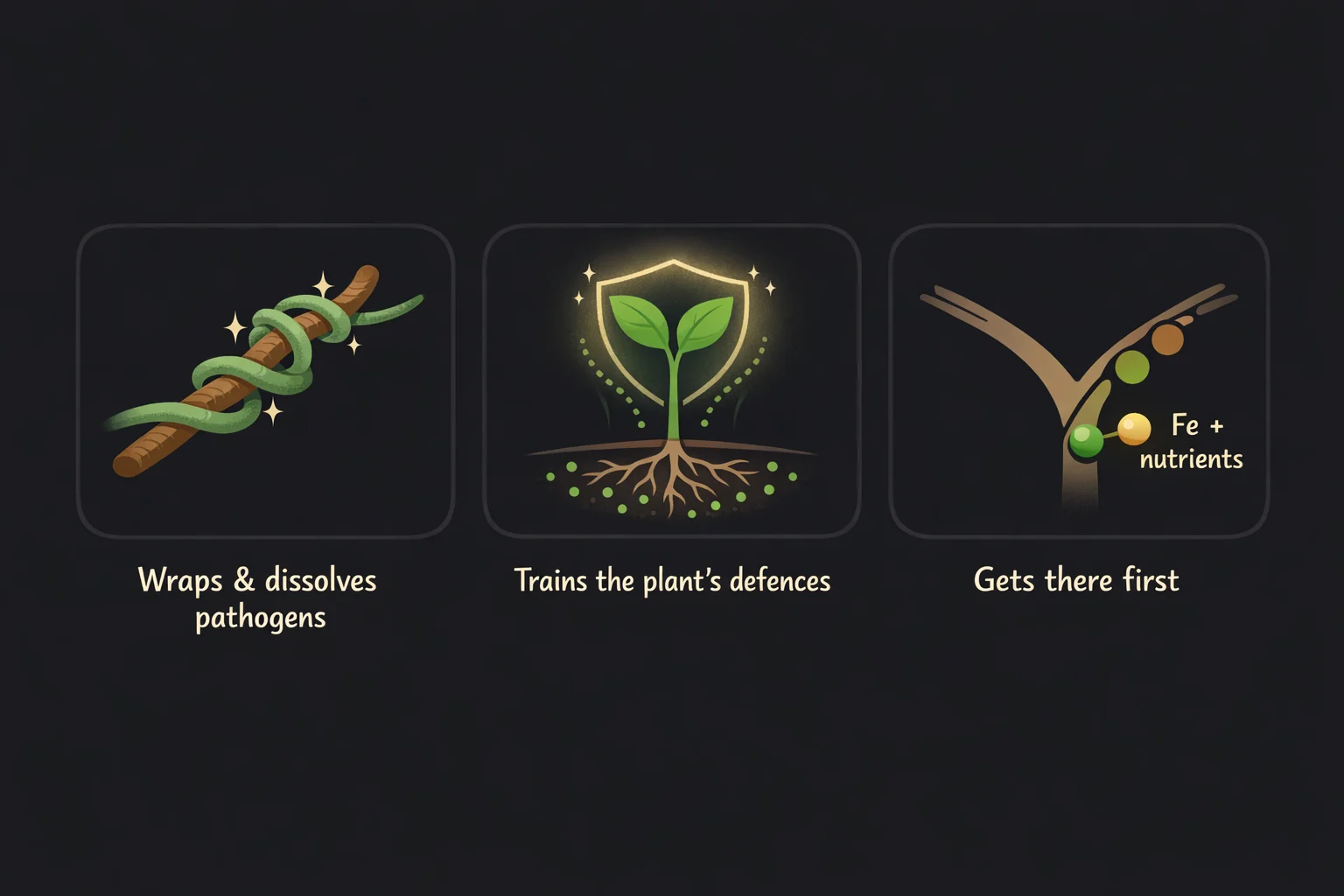
A — How Trichoderma Protects Your Plants
Trichoderma fungi don't form the deep nutrient-exchange partnerships that mycorrhizal fungi do. Instead, they colonise the root surface and the soil around it, working as active defenders through three distinct mechanisms.
Direct Attack
Trichoderma physically wraps around disease-causing fungi and digests them. It produces enzymes that break down pathogen cell walls — chitinases, glucanases, proteases — dissolving the enemy from the outside in. This is mycoparasitism.
Immune Priming
When Trichoderma colonises roots, it triggers the plant's own defence pathways (JA, ET, and SA signalling) — training the immune system before any pathogen arrives. This is called Induced Systemic Resistance (ISR).
Competition
Trichoderma grows fast — faster than most pathogens. It grabs iron, space, and carbon before disease-causing fungi can establish. Some strains also produce antibiotics that suppress pathogen growth in the immediate vicinity.
Evidence of mycorrhizal compatibility. Laboratory assays show Trichoderma grows toward pathogens while avoiding ectomycorrhizal fungi, suggesting it can distinguish friend from foe (Stange et al. 2024). This has been tested with ectomycorrhizal species only — not arbuscular mycorrhizal (AM) fungi, which are more common in gardens. In practice, Trichoderma and mycorrhizal inoculants are routinely applied together without reported problems, but the direct evidence is still limited.
B — What's Actually Available to Home Gardeners
There are many products labelled "Trichoderma" online and in garden centres. But Trichoderma is a large genus, and not all strains are equal. Our criteria:
These are the criteria we use in Olier's recommendation engine when matching Trichoderma allies to plants in a guild. We also prefer strains backed by peer-reviewed field studies, though we recognise that EPA/EU registration itself requires efficacy data even when that data isn't publicly available. Multiple registered strains exist (see the full table below), but these are the current CABI-listed products we selected for our engine. Registration data sourced from the CABI BioProtection Portal.
RootShield & RootShield Plus
BioWorksA long-running US Trichoderma product line. T-22 has been EPA-registered since 1990. RootShield products are sold in wettable-powder and granular forms for soil application, and RootShield Plus adds G-41 for EPA-reviewed Rhizoctonia and Fusarium claims.
Trianum G & Trianum P
KoppertSame T-22 strain as RootShield, but sold by Koppert. Current local CABI records show Trianum products in the US and UK, and the same strain also appears in research literature under the Trianum name.
Obtego
SePROA US product using the same ICC 012 + ICC 080 combination found in Bio-Tam 2.0. ICC 012 provides direct mycoparasitism at warmer temperatures, while ICC 080 contributes antibiosis via volatile compounds and remains active even at cool temperatures (~10°C). The pairing is designed for broader coverage across seasons.
Remedier / Bioten
Gowan (EU)EU-market products built around the same ICC 012 + ICC 080 pair. Local CABI records confirm Bioten in Germany, and EPA trade-name files for ICC 080 include both Bioten WP and Remedier WP. Same strains and overall biological logic as Obtego.
What about generic Trichoderma products? Many products sold online list only a species name such as "Trichoderma harzianum" or "Trichoderma viride" without specifying a strain. These may contain viable fungi, but without strain identification there's no way to verify what's in the bottle, match it to published research, or predict which diseases it targets.
Which diseases do they target?
| Disease | Pathogen | Product | Evidence | Authority |
|---|---|---|---|---|
| Damping-off | Pythium spp. | RootShield, Obtego | EPA label | ICC 080 BRAD |
| Root rot | Rhizoctonia spp. | RootShield Plus, Obtego | EPA label | G-41 BRAD + ICC 080 BRAD |
| Fusarium wilt | Fusarium spp. | RootShield Plus (G-41) | EPA label | G-41 BRAD |
| Phytophthora root rot | Phytophthora spp. | Obtego, Remedier | EPA label | ICC 080 BRAD |
| Sclerotinia rot | Sclerotinia spp. | Obtego, Remedier | EPA label | ICC 080 BRAD |
| Verticillium wilt | Verticillium spp. | Obtego, Remedier | EPA label | ICC 080 BRAD |
| Vine wood disease EU | Phaeomoniella, Neofusicoccum spp. | Vintec (SC1) | EFSA-reviewed | EFSA SC1 2015 |
EPA label = pathogen appears in the EPA Biopesticide Registration Action Document (BRAD) or fact sheet. EFSA-reviewed = the active substance was reviewed for grapevine use at EU level, but the public EFSA summary does not publish a simple pathogen list like the EPA BRAD does. Trichoderma products work best when used preventively, before disease pressure builds. Most commercial products focus on soilborne or vine-wood disease prevention, though the wider literature also includes induced-resistance examples against some viral and foliar diseases.
C — What the Research Shows
We evaluate each strain individually. EPA and EU registration means government scientists reviewed proprietary safety and efficacy data — but we also look at what independent researchers have published.
T. harzianum T-22 RootShield
123% yield increase in soybean
Harman reported broad T-22 root colonisation across many crops, and one soybean field trial showed a 123% yield increase (Harman 2000).
Root growth and anthracnose benefit in maize
In maize, T-22 produced roots nearly 2× longer and reduced anthracnose symptoms after Colletotrichum graminicola inoculation (Harman 2004).
57–78% Fusarium wilt reduction
Lettuce greenhouse trial — 57% in dry conditions, 78% in wet (Innocenti 2015).
ISR confirmed against virus
T-22 root colonisation triggered JA/ET + SA pathways, reducing cucumber mosaic virus severity in tomato (Vitti et al. 2016).
Honest caveat. An independent lab comparison of EU-market Trichoderma formulations (Kulik et al. 2025) found T-22 (tested as Trianum-G, not the US RootShield formulation) was the only biofungicide strain unable to fully overgrow Fusarium graminearum in vitro — achieving 53.7% inhibition versus 100% for all other tested strains. The pathogen tested (F. graminearum, a cereal disease) differs from the soilborne Fusarium species RootShield is marketed against. T-22 may work more through immune priming and competition than through direct mycoparasitic attack on Fusarium specifically.
T. asperellum ICC 012 + T. gamsii ICC 080 Obtego / Remedier
62–89% disease reduction over 9 years
Grapevine Esca complex across 4 vineyards in 2 Italian regions — the strongest long-term field data for any Trichoderma biofungicide in our collection (Di Marco et al. 2022). Efficacy was cultivar-dependent: best in Trebbiano/Lambrusco (88–89%), lower in Cabernet Franc (62%). Study was partially industry-funded.
100% overgrowth of three pathogens
ICC 012 (tested from EU Remedier formulation) achieved complete overgrowth of Botrytis cinerea, Fusarium graminearum, and Sclerotinia sclerotiorum in vitro — the strongest mycoparasitic performance of all strains tested (Kulik et al. 2025).
These two strains were designed as a combination — ICC 012 excels at direct mycoparasitism at warmer temperatures, while ICC 080 contributes volatile-mediated antibiosis and stays active even at ~10°C, providing complementary coverage across seasons and mechanisms.
T. virens G-41 RootShield Plus (2nd strain)
EPA registered 2012 (PC-176604)
EPA registered G-41 in 2012 and its public fact sheet names Rhizoctonia and Fusarium among the target soilborne fungi.
Public disease literature is thinner
In our current source set, G-41 is backed more clearly by EPA-reviewed registration files than by independent peer-reviewed disease papers.
Transparency note. G-41 has EPA-reviewed disease claims, but the public evidence we found is thinner than for T-22 or the ICC 012 + ICC 080 combination. We include RootShield Plus because it pairs a long-registered T-22 strain with a second EPA-registered strain that adds reviewed Rhizoctonia and Fusarium claims.
D — Why Strain Identity Matters
This is why Olier's disease engine only recommends products with identified, registered strains — not generic "Trichoderma" products.
Not all Trichoderma are equal
In an independent lab comparison of EU-market formulations (Kulik et al. 2025), T-22 inhibited Fusarium graminearum by only 53.7% while T-34, SC1, and ICC 012 all achieved 100%. This was an in vitro plate assay, not a field test — but it illustrates the point: species name alone tells you almost nothing. Trichoderma harzianum isn't a single organism. The genus is undergoing major taxonomic revision; T-22 itself may actually be T. afroharzianum rather than T. harzianum.
Quality control requires a named strain
Independent testing of EU-market Trichoderma products (Kulik et al. 2025) found every product tested contained fewer viable cells than claimed, and some shortfalls were much larger than a simple 3× or 6× gap. Vintec (SC1) claimed 9×10⁹ CFU/g but delivered 1.5×10⁹; Trianum-G (T-22) claimed 1.5×10⁸ but delivered 3.7×10⁷. These were EU formulations, not the US products listed above — but the finding is a strong argument for buying registered products where manufacturers are accountable to regulatory standards, rather than unregistered generics where no one is checking.
Generic ≠ biocontrol
Many products marketed as "Trichoderma" are sold as biofertilisers, not disease control agents. They may promote growth but have never been tested or registered for pathogen suppression. Kulik et al. (2025) found the quality gap is especially stark for biofertilisers — two of four tested had dramatically reduced viable cell counts, and most showed weak or no mycoparasitic activity against pathogens. Without EPA or EU registration for disease claims, there's no regulatory body verifying the product does what the label implies. Biofertilisers are rarely registered with government authorities.
Our selection criteria
Olier's fungal disease engine recommends a product only when these conditions are met: a specific strain is named on the label, that strain holds EPA, EFSA, or equivalent registration, and the product is actually purchasable by home gardeners. We also prefer strains backed by peer-reviewed field studies, though we recognise that EPA/EU registration itself requires efficacy data even when that data isn't publicly available. Many Trichoderma strains are registered (see the full table below) — but only a handful of those are sold in formats accessible to home gardeners rather than commercial growers.
E — Using Trichoderma in Your Garden
Apply early
Trichoderma needs time to colonise roots. Soil drench or granular application at planting or transplanting usually gives the best chance to establish before pathogens arrive.
Separate from chemical fungicides
As living fungi, Trichoderma are likely susceptible to broad-spectrum chemical fungicides. If you use both, apply them at different times rather than simultaneously. The T-39 strain showed its best results when integrated as an alternative to chemical sprays in a weather-based decision system, cutting fungicide use by 60% with equivalent disease control (Shtienberg & Elad 1997).
Store cool, use before expiry
Real-world viable cell counts are already lower than label claims. Heat and age reduce viability further. Keep products sealed and cool until use.
Set realistic expectations
Trichoderma works best preventively, not as a rescue treatment after heavy disease is established. Results vary significantly — the best field trials show about 60–89% disease reduction, but some strains in some conditions show much less, and one field trial (GL-21 vs lettuce drop) showed no effect at all. It works best as part of a diverse planting — which is exactly what guild design provides: varied root zones, structural complexity, and habitat for natural predators.
Use caution with mycorrhizal mixes
Trichoderma and mycorrhizal fungi occupy different ecological roles — one is a root defender, the other a nutrient partner. Lab evidence shows Trichoderma preferentially grows toward pathogens rather than ectomycorrhizal fungi (Stange et al. 2024). That is encouraging, but direct evidence for arbuscular mycorrhizal (AM) compatibility is still limited, so we treat this combination as plausible rather than fully proven.
F — Full Registration Status
Every strain we evaluated, and where it stands with regulators. Only strains with EPA or EU registration appear in Olier's recommendations.
| Strain | EPA (USA) | EU | AU | CIBRC (India) | Consumer product |
|---|---|---|---|---|---|
| T. harzianum T-22 | Yes PC-119202 | Yes GB listed | No | No | RootShield, Trianum |
| T. virens G-41 | Yes PC-176604 | No | No | No | RootShield Plus (w/ T-22) |
| T. asperellum ICC 012 | Yes | Yes DE listed | No | No | Obtego, Remedier, Bioten |
| T. gamsii ICC 080 | Yes PC-119207 | Yes DE listed | No | No | Obtego, Remedier, Bioten |
| T. atroviride SC1 | Yes 92083-2 | Yes Low-risk | No | No | Vintec |
| T. atroviride I-1237 | No | Yes DE, GB | No | No | Tri-Soil, Esquive |
| T. harzianum T-39 | Archived EPA | Current listing unclear | No | No | Trichodex (likely discontinued) |
| T. asperellum T34 | Yes PC-119209 | Yes DE listed | No | No | Asperello, Xilon, RootDei |
| T. virens GL-21 | Yes 70051-3 | No | No | No | SoilGard (Certis) |
| T. viride T-76 | Archived EPA | Current listing unclear | No | No | BINAB T (likely discontinued) |
| T. atroviride AT10 | No | Yes DE | No | No | Tricoten WP |
| T. viride TV-5 | No | No | No | Yes CIBRC | Kaveri TV-5 entry seen in local CABI data |
Strains dimmed are not part of Olier's current recommendation set for home gardeners. `Archived EPA` means the strain appears in historical EPA registration material, while current consumer availability is limited or unclear in our local CABI snapshots.
How EU registration works. At a high level, EFSA reviews the active substance (the strain itself) and member states authorise specific commercial products nationally. On this page, `EU listed` means we found the strain or product in local EFSA and CABI records rather than relying only on marketing copy.
India. Our local CABI data includes a named TV-5 product entry from Kaveri Organic Agri Inputs. We have not yet re-harvested enough India-specific regulatory and marketplace material to make stronger claims about how common named-strain consumer products are there, so we treat this area as still incomplete.
G — Common Questions
What is Trichoderma and how does it protect plants?
Trichoderma are beneficial soil fungi that protect plants through three mechanisms: mycoparasitism (wrapping around and digesting pathogenic fungi), induced systemic resistance (priming the plant's own immune defences via JA/ET/SA signalling), and competition (outcompeting pathogens for iron, space, and nutrients). They colonise the root surface rather than forming deep nutrient-exchange partnerships like mycorrhizal fungi.
Which Trichoderma products are registered for home gardens?
The main named products in our current local source set are RootShield / RootShield Plus (BioWorks, strains T-22 + G-41), Trianum G / Trianum P (Koppert, strain T-22), and Obtego (SePRO, strains ICC 012 + ICC 080). In the EU, local CABI records also show Bioten and related ICC 012 + ICC 080 products. All use named strains with regulatory records behind them.
Is Trichoderma safe to use with mycorrhizal inoculants?
Laboratory evidence shows Trichoderma preferentially grows toward pathogens rather than beneficial ectomycorrhizal fungi (Stange et al. 2024). That makes compatibility look promising, but direct evidence for arbuscular mycorrhizal (AM) compatibility is still limited. We treat the combination as plausible rather than fully proven.
Can I use Trichoderma with chemical fungicides?
As living fungi, Trichoderma are likely susceptible to broad-spectrum chemical fungicides. If you use both, apply them at different times rather than simultaneously. Research on the T-39 strain showed that alternating between biological and chemical treatments in a weather-based decision system cut fungicide use by 60% with equivalent disease control (Shtienberg & Elad 1997).
Why should I avoid generic Trichoderma products without a strain name?
Trichoderma is a large genus with strains that behave very differently. Independent testing (Kulik et al. 2025) found that some strains achieved 100% pathogen overgrowth while another managed only 53.7%. Biofertiliser-grade products without named strains also showed bigger quality-control gaps and weaker disease-fighting activity. Without a registered strain, there's no reliable way to verify what's in the bottle.
How effective is Trichoderma at preventing plant disease?
Results vary by strain, pathogen, and conditions. The best long-term field trial showed about 62–89% disease reduction over 9 years (ICC 012 + ICC 080 against grapevine Esca). T-22 showed 57–78% Fusarium reduction in greenhouse trials. However, some strains in some conditions show much less, and one trial (GL-21 vs lettuce drop) showed no effect. Trichoderma works best when used early and preventively, not after disease is already well established.
Is Trichoderma organic?
Some US Trichoderma products in our local CABI records do carry OMRI (Organic Materials Review Institute), including Obtego, Bio-Tam 2.0, RootShield Plus, and T-22 HC. OMRI status can differ between closely related products, so it is still worth checking the exact label in your region.
References
Regulatory documents