Bacillus thuringiensis
Bt is not one universal spray. Think of it as a family of different Bt types, each built for a different insect problem: Btk for Caterpillars, Bta when some brassica caterpillars stop responding to Btk, Bti for fungus gnat and mosquito larvae, Btg for Beetles such as grubs, and Btt for Colorado potato beetle systems.
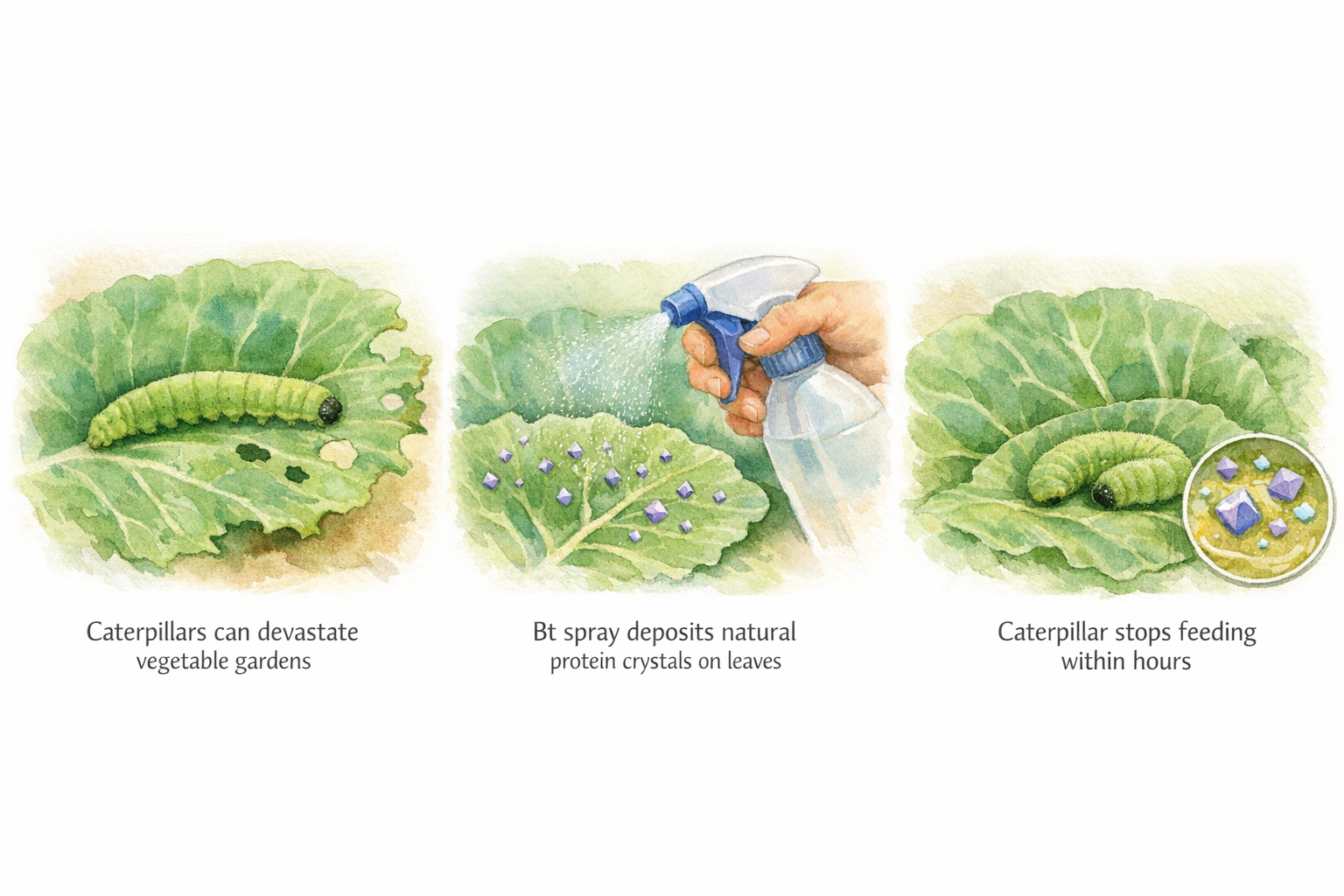
A — How Bt Works
Bt does not work like a contact spray. The pest has to eat it. Inside the gut of a susceptible larva, the Bt toxin switches on, damages the gut lining, and stops feeding. In simple terms: if the larva does not eat the spray, Bt cannot do its job (Bravo et al. 2011).
Crystal Protein Toxins
Bt makes tiny protein crystals called Cry and Cyt toxins. Different Bt types make different toxin mixes, which is why one Bt product works on caterpillars while another works on mosquitoes or grubs (Jouzani et al. 2017).
Gut Chemistry Lock
The toxin only turns on properly in the right kind of insect gut. That is one reason Bt can be so selective instead of acting like a broad "kill everything" spray (Bravo et al. 2011).
Receptor Specificity
Even after the toxin switches on, it still has to match the right gut receptors. That is part of why Btk, Bta, Bti, Btg, and Btt hit different pest groups. A 25-study meta-analysis did not find lower honey bee survival in laboratory studies of the Cry proteins used in commercialized Bt crops (Duan et al. 2008).
Targeted does not mean zero side effects. Bt has a favorable safety profile in the research we reviewed, but it should not be treated as a magic spray with no tradeoffs. The bee-safety evidence is reassuring, while the wider ecology papers remind us that persistence and non-target effects still matter, especially for Bti in aquatic settings.
B — Why the Bt Type Matters
The biggest mistake gardeners make with Bt is treating it like one product. It is not. The name Bacillus thuringiensis covers several different types of Bt, and each one fits a different pest problem.
We apply the same selection criteria across all our biocontrol guides for Olier's recommendation engine within the plant guild builder. For Bt, that means choosing the right Bt type first, then the product that carries it.
We also prefer products backed by independent, peer-reviewed studies. For Bt, most of the evidence sits at the "type of Bt" level, while some labels go one step deeper and name a strain such as SA-12, HD-1, or ABTS-1857.
In practice, Btk is for Caterpillars, Bta is the main fallback when some brassica pests stop responding to Btk, Bti is for fungus gnats and mosquitoes, and Btg and Btt cover the Beetles side of the Bt story used across the encyclopedia.
C — The Main Bt Types
These are the main Bt types that matter to gardeners. We lead with the plain-English use, then show the products underneath.
Where a pest lines up with the encyclopedia taxonomy, we use the same canonical categories here too, mainly Caterpillars and Beetles. The mosquito and fungus gnat side of Bt sits outside that herbivore-category set, so those stay as plain descriptive labels.
Btk — Bt for Caterpillars
Bt kurstaki is the usual Bt spray for leaf-eating caterpillars on brassicas, tomatoes, corn, beans, ornamentals, and trees. When most gardeners say "Bt spray," this is usually the one they mean.
Thuricide / Captain Jack's BT
BonideA standard home-garden Btk concentrate for caterpillars on leaves. This is the everyday Bt use case, not the mosquito or beetle one.
Monterey B.t.
Lawn & Garden ProductsAnother SA-12 Btk product. The important comparison here is not Monterey versus Bonide, but Btk versus the other kinds of Bt.
DiPel DF / Safer Caterpillar Killer II
Valent / SaferThe classic HD-1 version of Btk. This is one of the best-known and best-studied Btk lines in the caterpillar literature.
Bta — Backup Bt for Caterpillars
Bt aizawai matters most in brassica-heavy situations where Btk is no longer doing enough, especially with diamondback moth. It is not just another brand. It is a different kind of Bt.
Xentari
Valent / multiple marketsThe main Bta product to reach for when Btk is no longer enough. This is the product most often discussed when diamondback moth pressure pushes growers beyond the usual Btk spray, and it also shows up often in European box-tree-moth conversations.
Europe note. Bta is also the branch most often discussed for box tree moth pressure in European consumer channels, which is why products such as Xentari show up so often in boxwood conversations.
Bti — Bt for Mosquito and Fungus Gnat Larvae
Bt israelensis is not the same tool as Btk. It is the mosquito-and-gnat version of Bt, used in standing water, wet containers, and houseplant or seedling media.
Mosquito Bits
Summit ChemicalA practical Bti option for fungus gnat drenches and similar jobs. This is a completely different use from spraying caterpillars on leaves.
Mosquito Dunks
Summit ChemicalThe standing-water version of the Bti story. This is for mosquito larvae, not for caterpillars on leaves.
Btg — Bt for Beetles, Especially Grubs
Bt galleriae is the grub-and-scarab side of the Bt market. Think Japanese beetle grubs and similar turf or ornamental beetle problems. The broader claims here are still more emerging than settled.
BeetleGONE!
Phyllom BioproductsA consumer-facing Btg product for Japanese beetle and lawn-grub problems. Use it as the grub/scarab branch of Bt, not as a caterpillar spray.
Btt — Beetle Bt for Colorado Potato Beetle
Bt tenebrionis (and the closely related san diego story) is the classic beetle-focused Bt branch for Colorado potato beetle control. Most gardeners will see this less often than Btk or Bti, but it matters because it shows that Bt is not only a caterpillar product.
Practical takeaway. Btt is important because it shows that "Bt for beetles" is real, but for most gardeners it is a narrower, more potato-beetle-specific story than the everyday Btk page traffic.
D — What the Research Says About Each Type
We look at each Bt type separately. That matters because the evidence for caterpillars, mosquitoes, and grubs is not all the same.
Btk — Best-supported for Caterpillars on leaves
This is the main Bt gardeners rely on for caterpillars
Bravo et al. (2011) describe Btk products as effective against many leaf-feeding caterpillars across agriculture and forestry. This is the strongest and most settled part of the home-garden Bt story.
It works best when you catch larvae early and keep coverage fresh
The persistence and larval-stage papers all point in the same direction: sunlight breaks Bt down, rain removes it, and bigger older larvae are harder to control.
Bta — The clearest "switch to this when Btk fails" Caterpillar option
Diamondback moth can stop responding to Btk but still respond to Bta
Tang and Tabashnik (1996) found very strong Btk resistance in some diamondback moth populations, while susceptibility to the aizawai-side toxin stayed much better preserved. That is why Bta belongs on the page as its own option.
Think of it as a backup Bt, not just another label
If repeated Btk use stops working well on brassica pests, Bta is the most evidence-backed next step inside the Bt family.
Bti — Clearly the right Bt for mosquito and fungus gnat larvae
This is the mosquito-and-gnat Bt, not the caterpillar Bt
Berry (2012) explains why Bti is the right branch for mosquito-style larvae. The later review literature adds useful caution about repeated aquatic use.
It is still worth using carefully in water
The newer ecosystem review literature shows that repeated mosquito-control use in aquatic systems can affect some non-target groups too, so Bti should still be used thoughtfully.
Btg — Promising for Beetles, but less settled than Btk
The best support is for scarabs and similar beetle problems
Li et al. (2023) connect Btg to Japanese beetle and scarab activity, with extra support in alfalfa-weevil contexts. Promising, yes. As settled as Btk, no.
Some broader claims are still ahead of the field proof
Some of the excitement around Btg comes from its toxin profile rather than a huge pile of garden-style field results. That makes it interesting, but still more emerging.
Btt — A narrower Beetle Bt, mostly for potato-beetle situations
Useful to know about, but not the everyday home-garden Bt
The literature places tenebrionis / san diego in the Colorado potato beetle branch of Bt rather than the general caterpillar branch. That makes it real, but narrower.
Bottom line. Bt is usually a very targeted tool, but it still needs to be matched to the right pest and used with some ecological common sense.
E — How To Make Bt Work
Bt usually fails for simple reasons: the wrong Bt type, poor coverage, too much sun or rain, or larvae that were already too big. These are the main rules that matter in practice.
The pest has to eat it
Bt is not a contact killer. The spray has to land where larvae are actually feeding, which is why leaf undersides and tender new growth matter so much.
Sunlight wears it down fast
Bt does not stay strong on leaves for long. Sunlight starts breaking it down quickly, so fresh coverage matters.
Rain can wash it off
Even moderate rain can remove a lot of Bt from treated leaves. If the plant gets washed, you may need to think in terms of starting over.
Small larvae are easier to stop than big ones
Bt works best early. Once the larvae are large and well established, control gets harder.
Look for feeding to stop first
The first sign of success is often less chewing, not instantly disappearing larvae. Ask whether the damage stopped before assuming the spray failed.
F — Pest-to-Strain Table
| Pest | Life stage | Which Bt | Evidence |
|---|---|---|---|
| Cabbage worm / looper | Larvae | Btk | Strong foliar fit |
| Tomato hornworm | Larvae | Btk | Standard Btk use case |
| Corn earworm | Larvae | Btk | Classic caterpillar branch |
| Diamondback moth | Larvae | Btk or Bta | Use Bta when Btk breaks down |
| Fungus gnat | Larvae in media | Bti | Dipteran-specific branch |
| Mosquito larvae | Larvae in water | Bti | Strong aquatic larvicide fit |
| Japanese beetle grubs | Larvae in turf | Btg | Emerging but plausible |
| Colorado potato beetle | Larvae | Btt | Beetle-specific, narrower market |
Bt acts on actively feeding larvae. It does not control eggs, pupae, or adult insects. Dimmed rows indicate thinner consumer-product coverage or a more emerging evidence base.
Category tags use the same canonical herbivore categories as the encyclopedia when one exists. The Bti rows are shown separately because mosquito and fungus gnat larvae are outside that herbivore category set.
G — Common Questions
Which type of Bt do I need?
Use Btk for the encyclopedia category Caterpillars. Use Bta when brassica caterpillars such as diamondback moth are no longer responding well to Btk. Use Bti for mosquito and fungus gnat larvae, which sit outside those encyclopedia herbivore categories. Use Btg and Btt on the Beetles side of the Bt story.
Why would I switch from Btk to Bta?
Because some pests, especially diamondback moth, can stop responding well to repeated Btk use. Bta is the clearest evidence-backed alternative inside the Bt family.
Does Bt kill adults, eggs, or pupae?
No. Bt is a feeding-larva tool. If the target is not actively eating treated tissue or material, Bt is the wrong mechanism.
I sprayed Bt and the pests are still visible. Did it fail?
Not necessarily. First check whether feeding stopped. If plant damage has slowed or stopped, Bt may already be working. If nothing changed, the usual reasons are the wrong Bt type, poor coverage, washed-off spray, or larvae that were already too old.
Is Bt the same as Bacillus subtilis or Bacillus velezensis?
No. Bt (Bacillus thuringiensis) is the insect-control branch. Bacillus velezensis and related disease-control Bacillus strains are used for fungal and bacterial disease suppression. Same genus, very different job. See our Bacillus disease guide for that side of the story.
H — Key References
Mechanism and subspecies overview
Strain-specific efficacy
Safety and environmental cautions
Application + persistence