Biocontrol Diversity
Ladybirds can eat a lot of aphids. But ladybirds alone aren't enough. The most resilient gardens deploy a layered defence — ground beetles at night, parasitoid wasps by day, spiders spinning webs, and fungi infecting pests from within the soil.
In plain terms: predators that work in completely different ways protect your garden more reliably than the same predator type in large numbers — but functional variety, not sheer species count, is what matters.
The Key Finding
From 51 studies across 73 predator species
When predator types differ — in hunting strategy, habitat, and prey range — they can suppress pests better than even the best single predator species alone.
Adding more predator species without adding functional variety does not reliably improve pest suppression. In meta-analysis, polycultures with low functional diversity did not significantly outperform the single best predator species — suggesting that redundant niches add little.
Greenop et al. 2018, Ecology — meta-analysis of 51 studies, 214 effect sizes
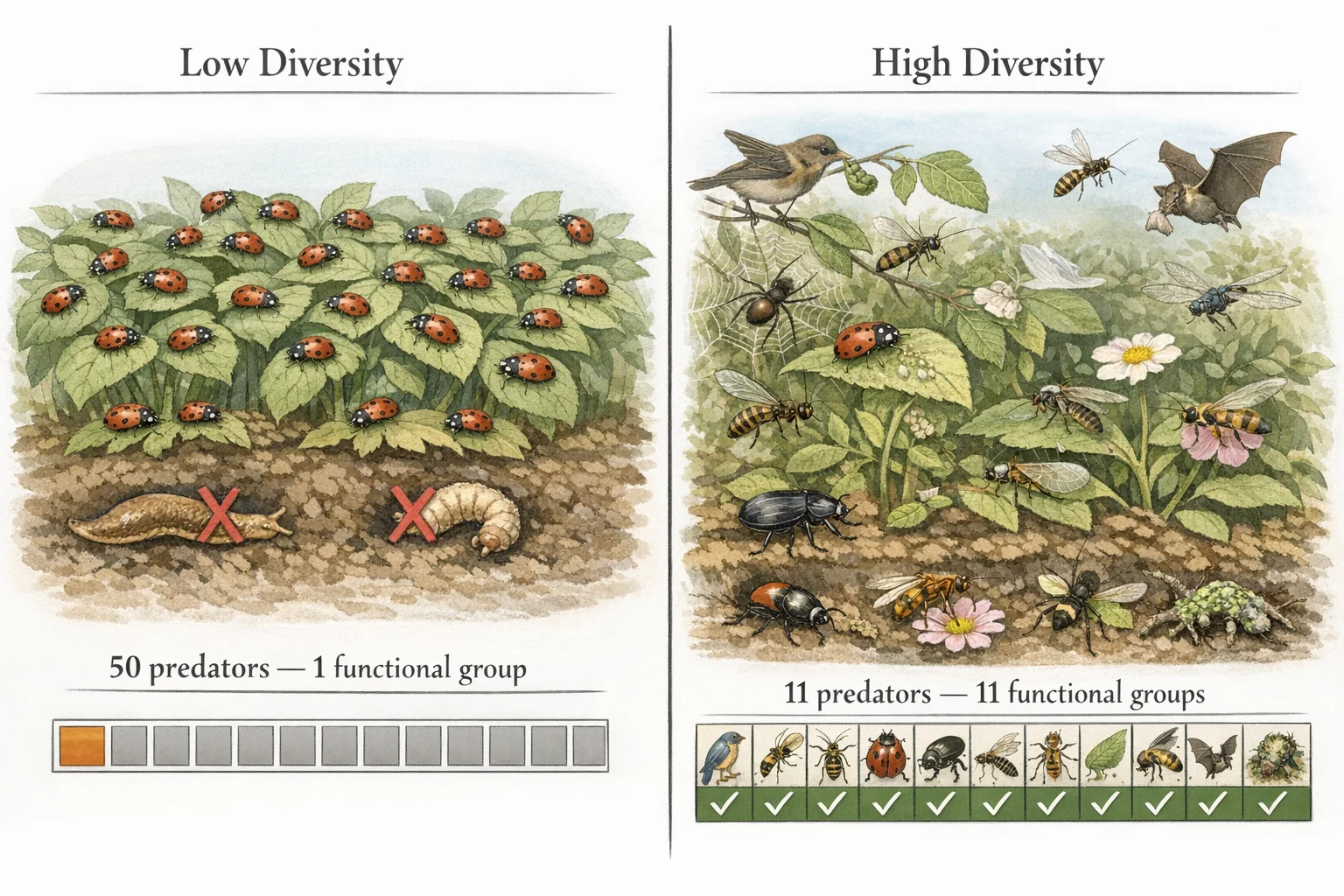
The research
What the Evidence Shows
Across dozens of independent studies, the conclusion is consistent:
more natural enemies (predators and parasitoids combined) in diverse cropping systems (flower strips, mixed plantings). 54% greater herbivore mortality on average. This meta-analysis measured total enemy abundance across 20+ higher taxa — spiders, parasitic wasps, predatory bugs, and more — without distinguishing functional groups.
Letourneau et al. 2011 — 45 articles, 552 experiments (aggregate natural enemy counts)
pest control success rate when mixed natural enemy communities (generalist predators, specialists, parasitoids) act together (27 experiments) — vs. ~79% for generalist predator assemblages alone (52 experiments).
Symondson et al. 2002, Annu. Rev. Entomol. — 181 manipulative field experiments total, 1960–2001
drop in pest control as the surrounding landscape shifts from diverse (semi-natural habitats, hedgerows, woodland) to dominated by cultivated land — measured across aphid-exclusion experiments in real crop fields. Rusch explicitly distinguished ground-dwelling predators (carabids, spiders) from vegetation-dwelling predators (ladybirds, hoverfly larvae) and parasitoids, finding that the combined multi-guild community drives the effect — no single guild alone shows the same response.
Rusch et al. 2016, Agric. Ecosyst. Environ. — 15 studies, 175 field sites, 5 countries (multi-guild analysis)
Why Diversity Beats Numbers
Each group fills a niche the others can't reach
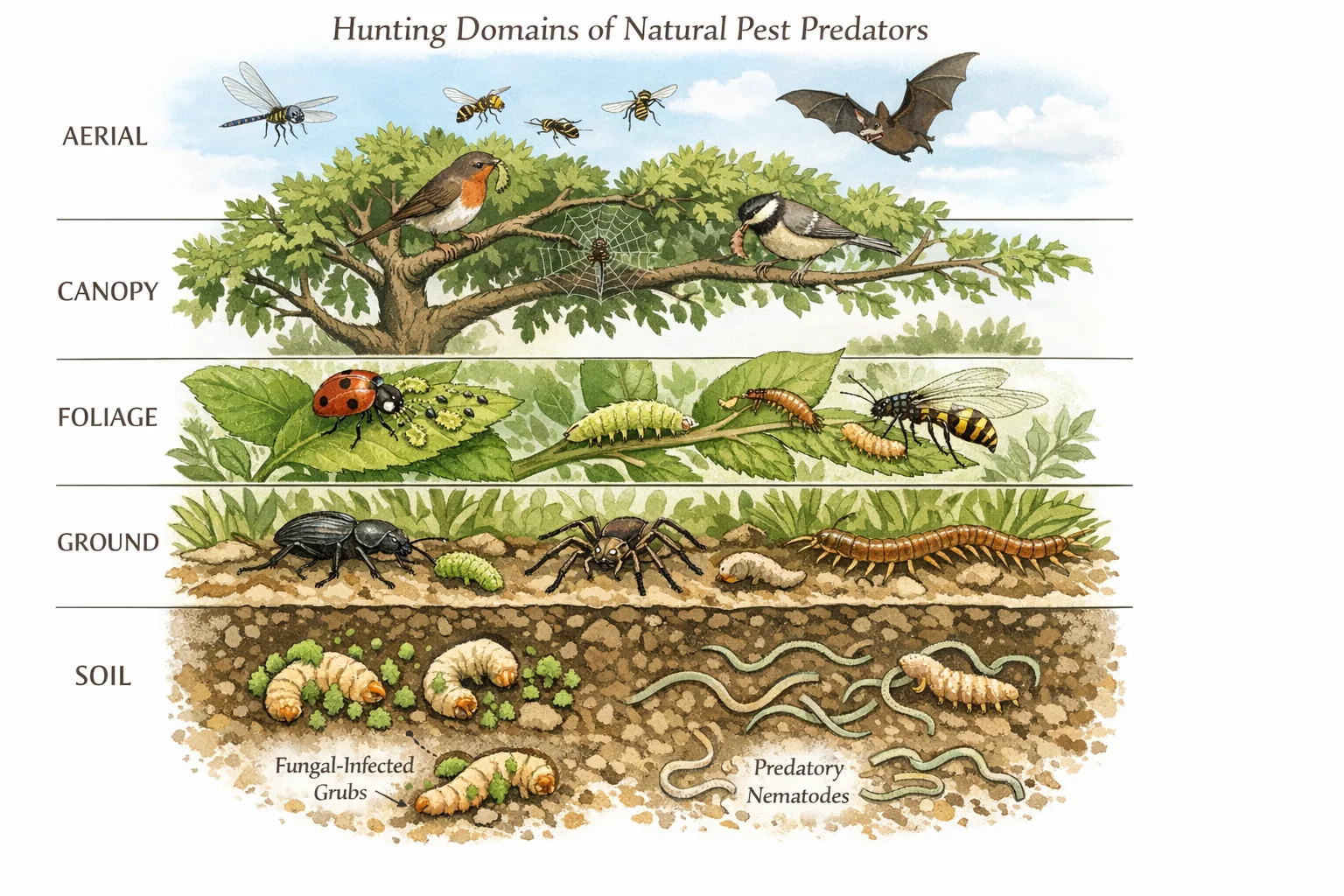
Spatial coverage is the most visible reason diversity works — but the research identifies at least four more:
Niche partitioning
Different groups hunt in different zones — sky, canopy, foliage, ground, soil — so pests have nowhere to hide. The diagram above.
Greenop et al. 2018; Rusch et al. 2016
Facilitation
One predator's behaviour directly helps another. Ladybirds dislodge aphids from leaves; the aphids fall to the ground where beetles eat them. The combined effect is greater than either predator alone.
Symondson et al. 2002; Rusch et al. 2016
Temporal insurance
Different predators peak at different times of day and season. If one group is less active in a bad year or at the wrong moment, others can still contribute — making the community as a whole more stable than any single predator type.
Greenop et al. 2018
Reduced intraguild predation
Predators that differ in hunting strategy and habitat are less likely to interfere with each other. Spatial separation and different feeding habits can mean fewer costly encounters between predator types.
Greenop et al. 2018; Symondson et al. 2002
Pathogen dissemination
Generalist predators physically spread insect-killing fungi as they move through the garden — breaking up pest aggregations and exposing them to disease at the same time.
Symondson et al. 2002
How we measure it
11 Functional Groups
We measure both how many types of pest control your guild attracts and how functionally diverse those types are. A guild with ground beetles, aerial birds, and soil fungi scores higher than one with three similar ground-hunting groups — because diverse hunting strategies cover more pest niches. Arranged sky to soil:
These 11 groups are our own classification, built from the three trait axes identified by Greenop et al. (2018) — hunting strategy, habitat domain, and diet breadth — extended to include vertebrates and soil microorganisms that are beyond the scope of their invertebrate meta-analysis.
Insectivorous Birds
Tits, warblers, flycatchers — canopy and aerial predation of large insects
Hunt in the canopy where few arthropod predators can match their speed and range. Respond to pest outbreaks across a whole garden or neighbourhood.
Bats
Insectivorous bats — the dominant nocturnal aerial predators
Temporal partners to birds — active after dark when birds sleep. Moths, beetles, and mosquitoes at night.
Broad-Habitat Generalists
Earwigs, harvestmen, sac spiders, jumping spiders — hunt across ground and foliage
Bridge the gap between sky and soil. Need connected pathways from ground to canopy — exactly what mixed growth forms provide.
Foliar-Active Specialists
Ladybirds, parasitoid wasps (which lay their eggs inside pests, killing them from within), lacewing larvae, hoverfly larvae, predatory mites
Specialists and generalists can complement each other — specialists target specific pests, while generalists fill the gaps between outbreaks.
Foliar-Active Generalists
Predatory bugs, assassin bugs, generalist ladybirds — opportunistic foliage patrollers
Switch prey as pest numbers shift. Persist on alternative prey between outbreaks — staying resident in the garden year-round.
Foliar-SW Generalists
Damsel bugs, nursery web spiders, cobweb spiders — motionless ambush on foliage
Stillness is the strategy — any movement would startle away the prey they target. This often means they catch a different mix of insects than active hunters do.
Foliar-AP Generalists
Crab spiders (Thomisidae) on flower heads — wait motionless, then actively chase
A hybrid strategy — different from pure sit-and-wait (which doesn't chase) and pure active hunters (which don't wait).
Ground-Active Generalists
Nocturnal ground-surface hunters — carabid beetles, wolf spiders, rove beetles
Major slug predators. Present before pests arrive and switch to alternative prey when pest numbers drop. (Symondson 2002)
Ground-Web Generalists
Sheet-web spiders at ground level — money spiders (Linyphiidae)
Passive interception traps that catch walking and low-flying prey. They intercept insects that active hunters would miss entirely.
Ground-Active Specialists
Predatory mites targeting specific soil arthropods
Tiny hunters that can reach soil arthropods larger predators often miss.
Entomopathogenic Fungi
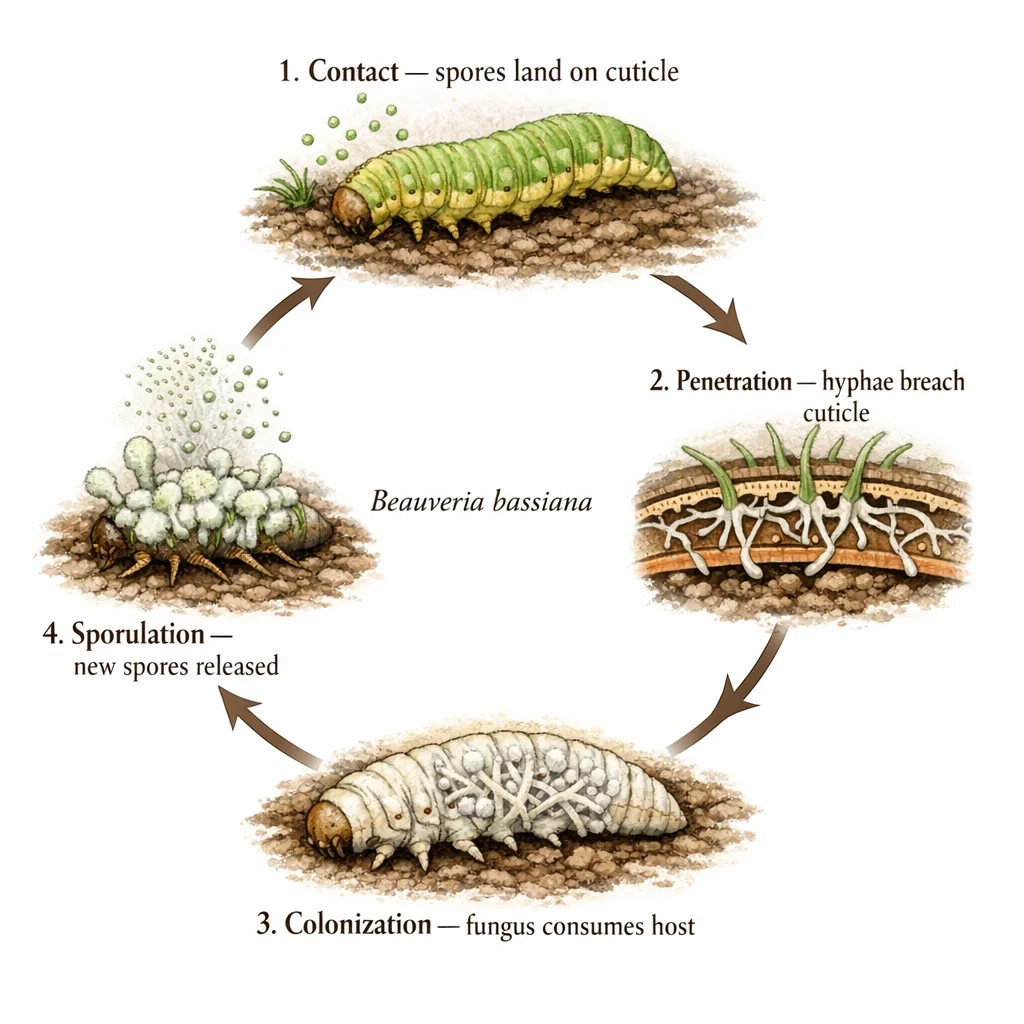
Beauveria, Metarhizium, Cordyceps, Hirsutella — fungi that infect and kill insects
Spores contact insect cuticle and penetrate it, growing inside the host. Can infect insects at multiple life stages, including soil-dwelling larvae and pupae. Some species colonise plant tissues as endophytes, providing protection from within. (Vega et al. 2008; Tscharntke 2007)
How We Score It
From your plants to a 0–100 score
Plants attract predators through the habitat, nectar, and microclimate they create. We use that relationship to estimate your guild's functional diversity:
Look up predator associations — for each plant in your guild, we query the Global Biotic Interactions database (GloBI) for all recorded predators.
A note on data completeness
No database can capture every creature in every garden. Our GloBI pull reflects documented interactions, so coverage is uneven across regions, plants, and predator groups.
We use GloBI as a working proxy for potential functional diversity. Think of your score as your guild's documented potential — what recorded interactions suggest it could attract — not a survey of what is there right now.
Map to functional groups — each predator family maps to one of the 11 groups based on its hunting strategy, habitat, and diet breadth.
Check fungi associations — we separately check if any guild plant hosts Entomopathogenic Fungi (group 11).
Score richness + functional diversity — we measure both how many of the 11 groups your guild attracts (richness) and how different those groups are from each other (Gower's Mean Pairwise Distance (MPD) across hunting strategy, habitat domain, and diet breadth). Your guild's raw score is group count + MPD.
Why richness + Gower MPD?
Greenop et al. (2018) analysed 51 biocontrol studies and found that functional diversity — predators differing in hunting strategy, habitat, and diet — is the strongest predictor of pest suppression. A guild with ground beetles, foliar ladybirds, and aerial birds covers three different hunting niches, giving pests fewer places to hide.
The same principle applies in pollination research: Hoehn et al. (2008) showed that the number of functionally distinct pollinator guilds explained 45% of crop seed set — more than species count alone (32%).
Normalise — we compare against the distribution of all possible guilds at your guild size (e.g. 4-plant guilds vs other 4-plant guilds). Percentile rank becomes the 0–100 score.
Why this matters: The more variety in your guild's predator groups, the more hunting strategies, habitats, and diet types are covered — and the fewer places pests can hide. Each additional group opens up a new axis of pest suppression that the others don't reach.
Improving Your Score
What plants attract diverse biocontrol agents?
Open-flowered plants — Apiaceae, Asteraceae, wildflower mixes
Small, open blooms provide accessible nectar for beneficial insects — hoverflies, lacewings, ladybirds, and parasitoid wasps. Nectar feeding increases parasitoid longevity and fecundity, supporting sustained pest control. (Tscharntke 2007; Hatt 2017)
Dense ground cover
Low, spreading plants and living mulches create dense ground cover that shelters web spiders and predatory mites. A meta-analysis of 43 studies found that habitat structural complexity significantly increased natural enemies, with web-building spiders showing one of the strongest responses. (Langellotto & Denno 2004)
Structural variety
Mix canopy trees, shrubs, and herbs. Broad-habitat hunters, birds, and bats benefit from connected pathways from ground to canopy — the kind of structural complexity that varied growth forms create.
Moist mulch layer
Wood chips and leaf litter support natural enemies — detritus habitats showed the strongest effect size in a meta-analysis of habitat complexity. The same habitat may also suit Entomopathogenic Fungi, some of which colonise plant tissues as endophytes. (Langellotto & Denno 2004; Vega et al. 2008)
One thing that undoes all of this
Broad-spectrum insecticides can wipe out ground and foliar predators. The same spray that kills your aphids can also kill the ladybirds, ground beetles, and parasitoid wasps that would otherwise help control outbreaks. Once disrupted, predator communities can take time to rebuild.
A guild is a combination of 3–6 plants chosen to work together. The Guild Builder scores how well their combined predator community covers all 11 functional groups.
Your garden's defence team is ready to be built. Discover which of the 11 predator groups your plants already attract — and which gaps to fill.
Try the Guild Builder