Pollinator Diversity
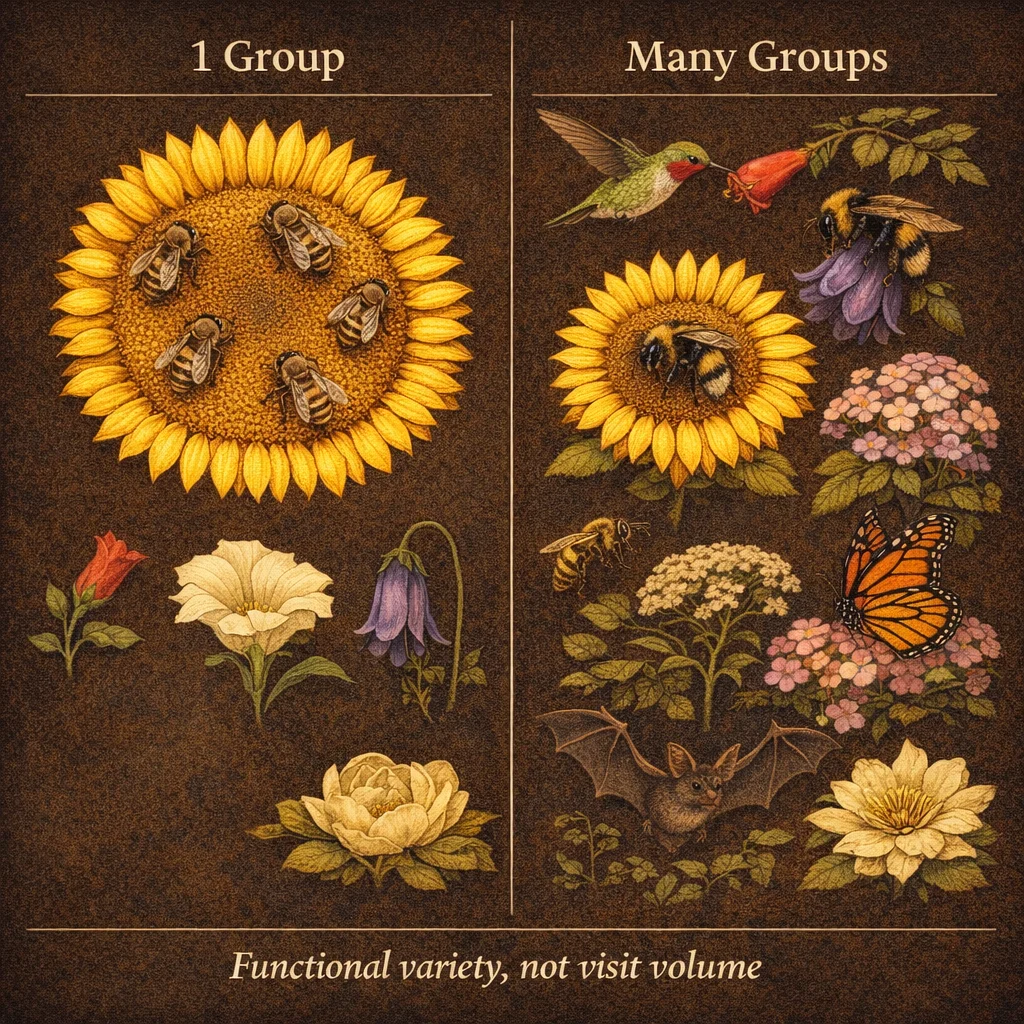
Honeybees are prolific foragers. But honeybees alone aren't enough. Diverse gardens benefit from a full team — Bumblebees in the cold dawn, Small Bees deep in flowers, Hoverflies through the day, and Moths after dark.
In plain terms: pollinators that work at different times, visit different flower shapes, and reach different parts of the bloom produce far more fruit and seed than any single type in large numbers.
The Key Finding
From pumpkin fields to global meta-analyses
Functional group diversity explains 45% of seed set variance — far more than species richness alone (32%). Large bees visiting early carry pollen between flowers; small bees arriving later distribute it within each bloom.
Wild insect visits enhance fruit set twice as much as equivalent honeybee visits — across 41 crop systems on six continents. Honeybees supplement but cannot substitute for diverse wild pollinators.
Hoehn et al. 2008, Proc. R. Soc. B & Garibaldi et al. 2013, Science
The research
What the Evidence Shows
Across dozens of independent studies, the conclusion is consistent:
fruit set enhancement from wild insect visits compared to equivalent honeybee visits — across 41 crop systems on six continents. Wild and managed pollinator contributions are independent and additive.
Garibaldi et al. 2013, Science — 41 crops, 6 continents
of crop visits come from non-bees — hoverflies, other flies, butterflies, beetles, moths. Their contribution is additive to bees, not redundant — adding non-bees to an already bee-rich site still increases fruit set.
Rader et al. 2016, PNAS — 39 studies, 5 continents
more functional visitation space when flies and butterflies join the team alongside bees. In the cotton system studied by Cusser and colleagues, bees alone covered only about two-thirds of the multidimensional visitation space. Adding non-bee pollinators filled the remaining gaps by visiting at different times and different positions on the plant.
Cusser et al. 2021, Agric. Ecosyst. Environ. — 67 species, Texas cotton
Why Diversity Beats Volume
No single group covers the whole 24-hour cycle
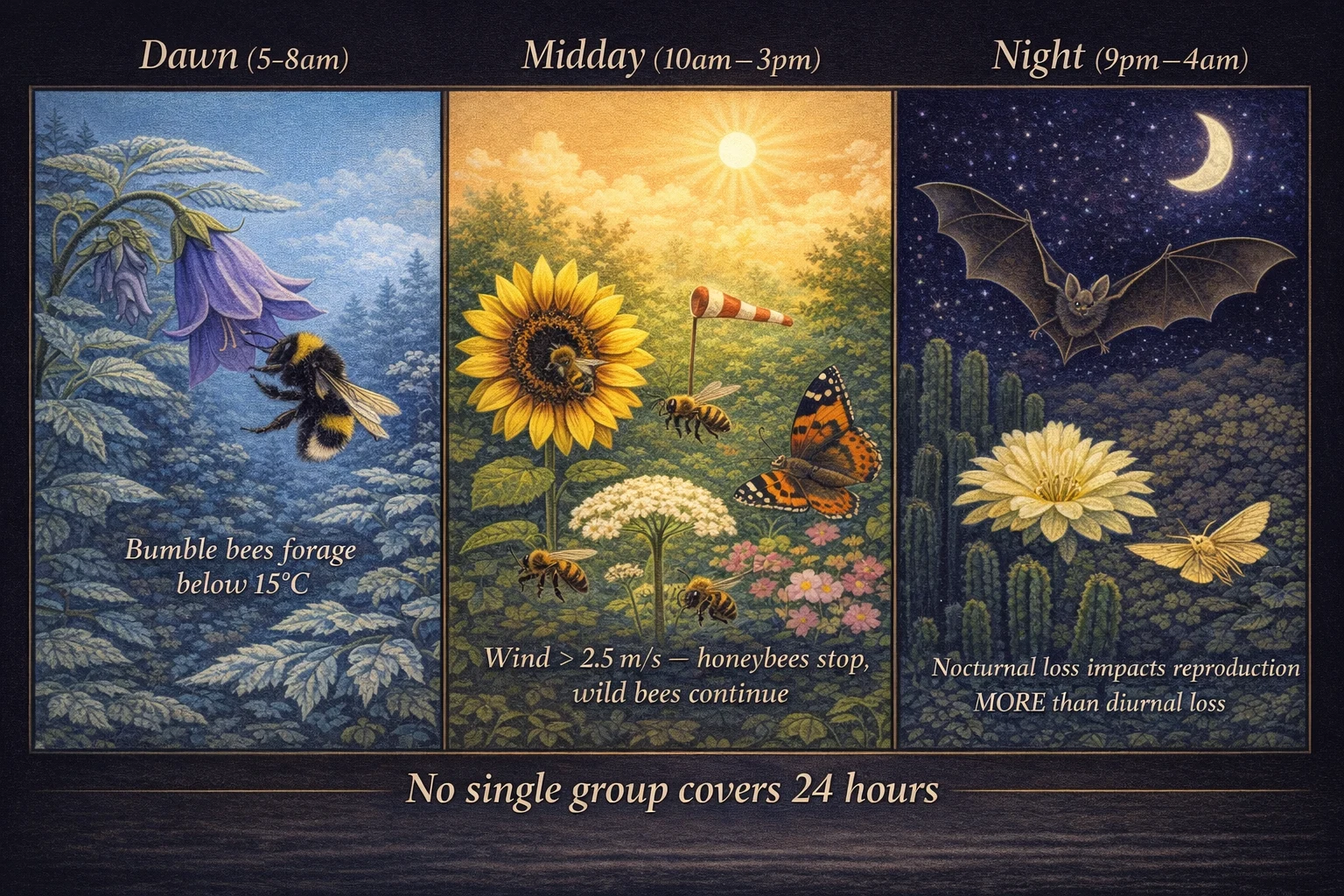
Time of day is the most visible reason diversity works — but the research identifies at least four more:
Temporal shifts
Different groups fly at different times of day and season. Flies arrive 1.5 hours before bees each morning; butterflies start 30 minutes earlier. Over a season, 2–3x as many species are needed as any single snapshot suggests.
Hoehn et al. 2008; Cusser et al. 2021; Lemanski et al. 2022
Weather buffering
Honeybees stop foraging above 2.5 m/s wind — visits drop to near zero. In diverse orchards, wild bees (Andrena rose from 7% to 37% of visits) kept working. Low-diversity orchards received almost no flower visits on windy days.
Brittain et al. 2013 — almond orchards, 3 years
Spatial coverage
Honeybees prefer the top of the tree canopy. Hoverflies and flies work the bottom sections. Bees visit inner floral positions; butterflies and flies reach the outer, more exposed flowers. No single group covers the whole plant.
Brittain et al. 2013; Cusser et al. 2021
Cross-pollination quality
Wild insects move between different plants more than honeybees, which tend to work the same plant repeatedly. The result: wild visits boost fruit set twice as much per visit — not because they carry more pollen, but because they carry pollen from different plants.
Garibaldi et al. 2013 — 41 crops, 6 continents
Within-flower position
Large bees touch the outer anthers, carrying pollen between flowers. Small bees crawl deep inside, distributing pollen within each bloom to parts larger pollinators can't reach. Neither alone achieves what their succession does together.
Hoehn et al. 2008 — pumpkin, 45% of seed set variance
Within-Flower Complementarity
Why body size differences matter at the scale of a single bloom

How we measure it
From Complementarity Axes to 13 Functional Groups
Pollinators don't just differ by species — they differ along axes of complementarity that independently affect pollination success (Blüthgen & Klein 2011). A pollinator that works at dawn covers a different axis than one that reaches deep tubular flowers. We score both how many groups your guild attracts and how functionally diverse they are across four axes:
| Axis | What differs | Key evidence | Groups that split here |
|---|---|---|---|
| Temporal | Time of day, season, activity window | Hoehn 2008; Blüthgen & Klein 2011 | Dawn Bumblebees → mid-morning Honey Bees → late-AM Small Bees → nocturnal Moths/Bats |
| Morphological access | Body size, tongue length vs flower depth | Blüthgen & Klein 2011; Stang et al. 2009 | Long-tongue bees → short-tongue hoverflies → chewing beetles |
| Within-flower position | Where pollen lands on the stigma | Hoehn 2008; Chagnon et al. 1993 | Large bees (apical) → small bees (basal) |
| Environmental tolerance | Wind, cold, rain resilience | Brittain et al. 2013 | Fair-weather Honey Bees → wind-hardy Small Bees → rain-tolerant Hoverflies → all-weather Birds |
When we cross these axes against recorded pollinator–plant interactions from the Global Biotic Interactions database (GloBI), 13 non-redundant clusters emerge — each occupying a unique combination of axis positions. No two groups below have the same profile. That's the test: if two pollinator types are redundant across all four axes, they belong in the same group.
Honey Bees
Colony foragers with mass recruitment — the baseline pollination workhorse for open-access flowers
High volume, but visits drop to near zero in wind above 2.5 m/s. (Brittain 2013)
Bumblebees
Bombus and other buzz-pollinating bees — vibration releases pollen from poricidal anthers that many other visitors can't access
Large body enables early-morning foraging. Among the earliest visitors, they carry pollen between flowers via bulk transfer. (Hoehn 2008; Brittain 2013)
Long-reach Bees
Osmia, Megachile, Anthophora — solitary bees with long tongues relative to body size
Access deep tubular flowers that large-bodied bees can't enter (Blüthgen & Klein 2011). Solitary nesting distributes pollination spatially rather than concentrating it around one hive.
Small Bees
Lasioglossum, Halictus, Andrena — tiny bees that reach deep inside flowers
Arriving later in the morning, they distribute pollen within each flower — walking across the stigma to reach parts that larger bees do not contact. Wind-hardy: Andrena rises from 7% to 37% of visits in high wind. (Hoehn 2008; Brittain 2013; Bluthgen & Klein 2011)
Stingless Bees
Trigona, Tetragonula, Melipona — tropical social bees that add a small-bodied colony-foraging niche
Included here as a small-bodied social-bee group distinct from the larger honeybee profile.
Hoverflies
Syrphidae — generalist pollen transporters with high visit frequency and hover-feeding behaviour
Some hoverfly species appear less affected by land use change than bees (Rader 2016). Preferentially visit lower canopy sections, showing a distinct spatial niche from honeybees (Brittain 2013).
Other Flies
Non-syrphid Diptera — blowflies, midges, bee-flies — additional fly families contributing beyond hoverflies
Calliphoridae, Tachinidae, and Empididae were identified as significant Diptera families beyond hoverflies (Rader 2016). They broaden the non-bee contribution instead of simply duplicating syrphid visits.
Butterflies
Long-range pollen transport — reaching outer floral positions that bees rarely visit
Together with flies, butterflies expand functional visitation space by about 50% relative to bees alone. They forage earlier than bees and reach outer parts of the bloom that bees skip. (Cusser 2021)
Wasps
Non-bee Hymenoptera — incidental pollinators during nectar foraging; obligate mutualists for figs
Contribute to functional diversity particularly in tropical systems. Fig wasps are irreplaceable — without them, no figs.
Moths (the surprise story)
Nocturnal Lepidoptera — a major insect pollinator group active after dark
In bat-pollinated systems (especially cacti), excluding nocturnal pollinators reduced reproduction more than excluding diurnal ones (Artamendi 2024) — though this is driven largely by bat exclusion experiments, so the pattern may not generalise to all gardens. Moths provide unique, highly complex pollen transport links that the daytime network cannot replace (Macgregor 2019).
Bats
Chiroptera — nocturnal, long-distance pollen transport with enormous pollen loads
Specialised for large, sturdy, night-opening flowers such as columnar cacti. In temporal exclusion experiments on columnar cacti, at least one species showed genuine synergy: fruit set with both bat + insect pollination exceeded the sum of each alone. (Fleming et al. 2001, via Bluthgen & Klein 2011)
Beetles
Coleoptera — a distinct crawling pollinator niche for broad, bowl-shaped, often heavily scented flowers
Included here as a different access mode from flying pollinators on broad, accessible blooms.
Birds
Hummingbirds, sunbirds, honeyeaters — pollinators of tubular flowers too deep for many insects
Can forage in rain and cool conditions when many insect pollinators are inactive. They matter most where deep tubular flowers are present.
How We Score It
From your plants to a 0–100 score
Plants attract pollinators through their flower shape, colour, scent, and bloom timing. We use that relationship to estimate your guild's functional diversity:
Look up pollinator associations — for each plant in your guild, we query the Global Biotic Interactions database (GloBI) for all recorded pollinators, plus floral trait data (tube depth, colour, scent, phenology).
A note on data completeness
No database captures every pollinator-plant interaction. GloBI records documented interactions from published studies worldwide — coverage varies by region and species. We supplement with floral trait matching (tube depth, colour, reward type) to infer likely visitors.
Think of your score as your guild's potential — the breadth of pollinator types your flowers could attract — not a census of what's visiting today.
Map to functional groups — each pollinator family maps to one of the 13 groups based on body size, tongue length, temporal niche, and foraging behaviour.
Score richness + functional diversity — we measure both how many of the 13 pollinator groups your guild attracts (richness) and how different those groups are from each other (Gower's Mean Pairwise Distance (MPD), with ordinal encoding, across temporal activity, morphology, feeding position, and environmental tolerance). Your guild's raw score is group count + MPD.
Why richness + Gower MPD?
Hoehn et al. (2008) tracked the 12 most abundant bee species visiting pumpkin flowers in Indonesia. By measuring three traits — visiting height, time of day, and body size — they classified bees into 8 functional guilds. The number of guilds present explained 45% of seed set variance, compared to just 32% for species count alone.
The mechanism is complementarity: large bees arrive early and transfer pollen in bulk, while small bees arrive later and distribute it across the stigma. Night-flying moths reach flowers that day-flying bees never visit. More groups means more complete pollination across time, space, and flower type.
Normalise — we compare against the distribution of all possible guilds at your guild size (e.g. 4-plant guilds vs other 4-plant guilds). Percentile rank becomes the 0–100 score.
Why this matters: The more variety in your guild's pollinator groups, the more time slots, flower shapes, and weather conditions are covered — and the more reliably your plants get pollinated. Each additional group opens up a new window of pollination that the others can't fill.
Improving Your Score
What plants attract diverse pollinators?
Flower shape variety — flat, tubular, and bowl
Dill and fennel (flat) for hoverflies, lavender and salvia (tubular) for long-tongued bees and butterflies, poppies and magnolias (bowl) for beetles. Morphological access is a primary complementarity axis (Bluthgen & Klein 2011) — and pollination syndromes link flower form to pollinator type (Fenster et al. 2004).
Bloom across seasons
Crocus in spring, clover in summer, aster in autumn. Across a growing season, 2–3x as many pollinator species are needed compared to a single snapshot — apparent redundancy dissolves into essential complementarity over time. (Lemanski 2022)
Night-flowering plants
Evening primrose, nicotiana, moonflower — white or pale, fragrant flowers that help recruit moths and other nocturnal visitors. They add nocturnal pollination links that daytime pollinators do not cover. (Macgregor 2019)
Colour diversity
Blue-purple can help recruit bees, while pale flowers are often associated with moth-pollination syndromes. Colour can broaden appeal, but it works best alongside flower shape, scent, and bloom timing (Fenster et al. 2004).
One thing that undoes all of this
Broad-spectrum insecticides — including many common garden sprays — can sharply reduce pollinator activity and abundance. The same spray that targets pest insects can also reduce visits from the pollinators your plants depend on. Building a diverse pollinator community takes time, so repeated spray use can erode it quickly.
A guild is a combination of 3–6 plants chosen to work together. The Guild Builder scores how well their combined flower offering covers all 13 pollinator functional groups.
Your garden's pollination team is ready to be assembled. Discover which of the 13 pollinator groups your plants already attract — and which gaps to fill.
Try the Guild Builder