Phylogenetic Diversity
When you mix plants which are distant relatives, the result is measurable: fewer shared pests and pathogens, higher productivity, and — in early evidence — richer soil life. One metric predicts all three.
In plain terms: the further apart your plants sit on the tree of life, the more likely they are to help each other.
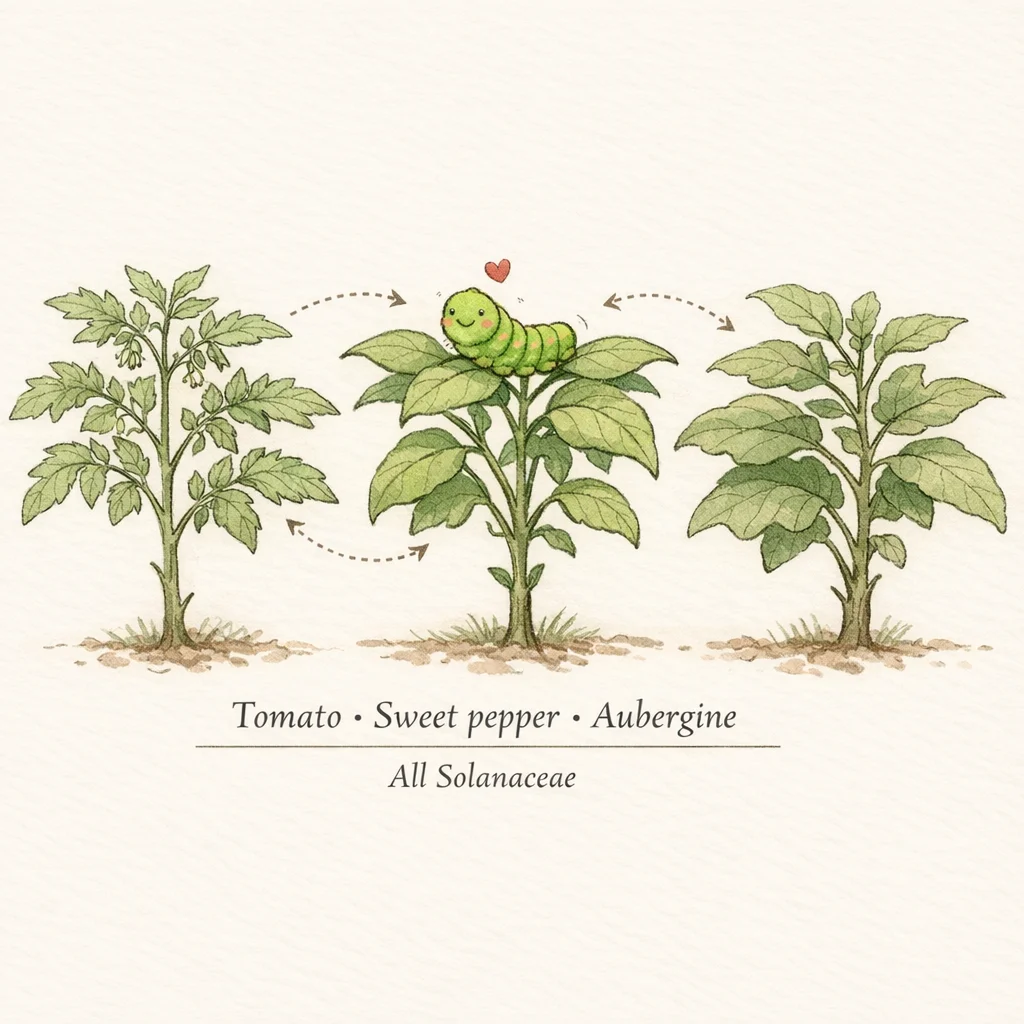
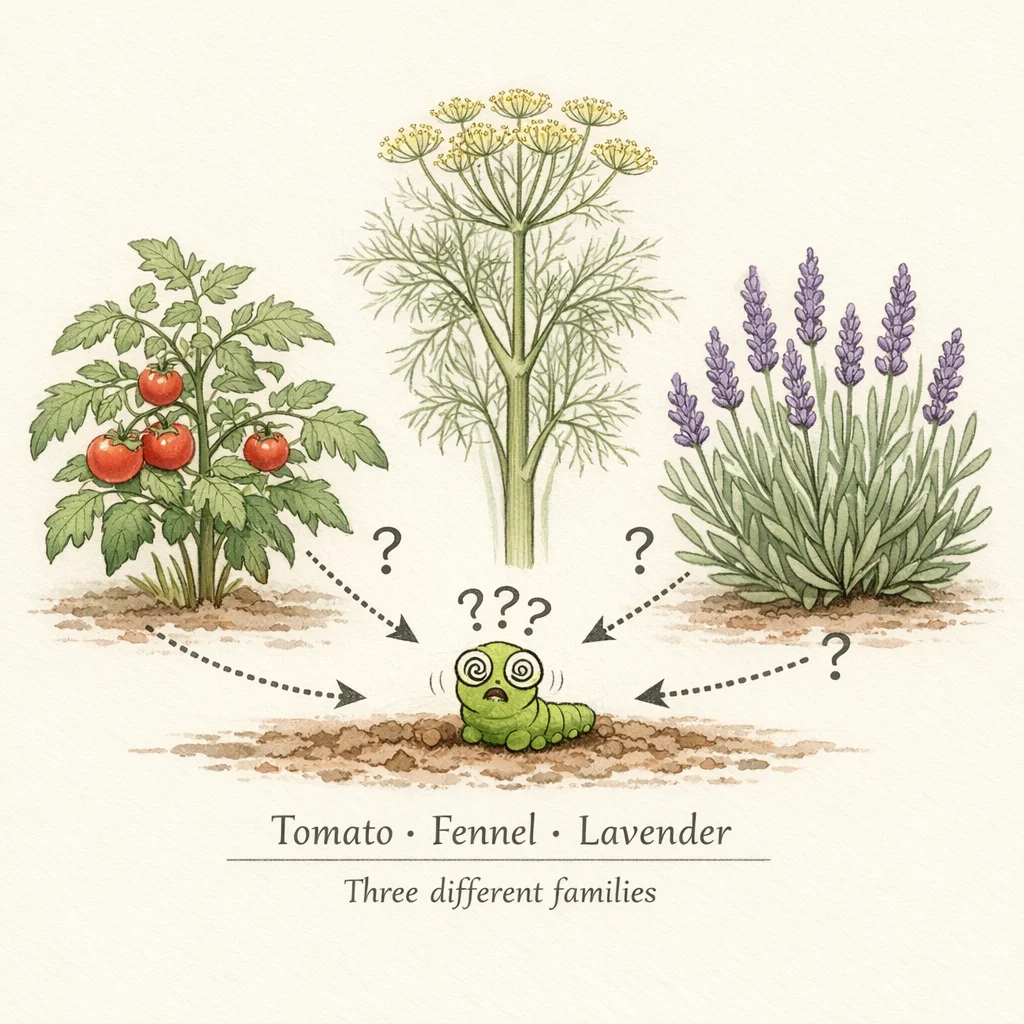
Pest defence was a key benefit scientists measured. But mixing the family tree turns out to predict much more.
A — The Pest & Pathogen Shield
A caterpillar that evolved to eat tomatoes needs to recognise a tomato — by its scent, leaf texture, and surface chemistry. A soil fungus that evolved to infect one plant needs to latch onto specific molecules on its roots. Both of these recognition systems took millions of years to fine-tune. Neither can be rewired overnight to attack a completely unrelated plant. The result: when your plants come from distant branches of the family tree, most specialists simply cannot find a host. Ecologists call this associational resistance.
This works against both fungal diseases and insect pests — and among invasive pests, fungal diseases show even stronger phylogenetic conservatism than insects (Gougherty & Davies 2021).
Fungal diseases
In a landmark experiment, researchers in Panama tested 53 foliar fungal pathogens across 962 cross-inoculation pairings and measured how often disease appeared — depending on how closely related the plants were. The pattern was clear:
66.7%
infection rate
Close relatives
e.g. tomato & potato
43.6%
infection rate
Same plant family
e.g. tomato & pepper
29.9%
infection rate
Distant relatives
e.g. tomato & carrot
Gilbert & Webb 2007
The relationship is continuous — not just three buckets. Using the same logistic model from the 962 experiments, here's what pathogen sharing looks like across the full range of evolutionary distance:
Distances are medians from Gilbert & Webb 2007. Risk calculated from their logistic model fitted to 962 cross-inoculation experiments.
Diseases are even pickier than insects — especially invasive ones. When Gougherty & Davies (2021) tracked how fast pest damage drops off as plants become less related, invasive fungal diseases showed the steepest decline of all four categories, followed by invasive insects, then native insects, and native fungi. The upshot: mixing plant families protects especially well against introduced pathogens.
A 2025 DNA study of 27,000 fungal DNA sequences confirmed the pattern: which plants a fungus can infect is shaped by both the plant's family tree and the fungus's own family tree. It's a two-sided constraint — evolution matters on both sides, even though some fungi still have broad host ranges (Silva-Valderrama et al. 2025).
Insect pests
Jactel et al. (2021) pooled 624 study cases from 69 papers spanning five decades of forest research. The verdict: specialist herbivores — the ones that target a specific tree — do measurably less damage when their host is surrounded by unrelated species. Generalist herbivores showed no clear reduction in the overall analysis — unrelated neighbours are a weaker barrier for insects that already feed broadly.
Every step helps — there's no magic boundary. Protection doesn't suddenly kick in at a specific level of relatedness. It increases gradually, with the biggest gains coming from separating close relatives. After that, each additional step still helps, just by smaller amounts. That's why our score uses the average evolutionary distance across all plant pairs in the guild.
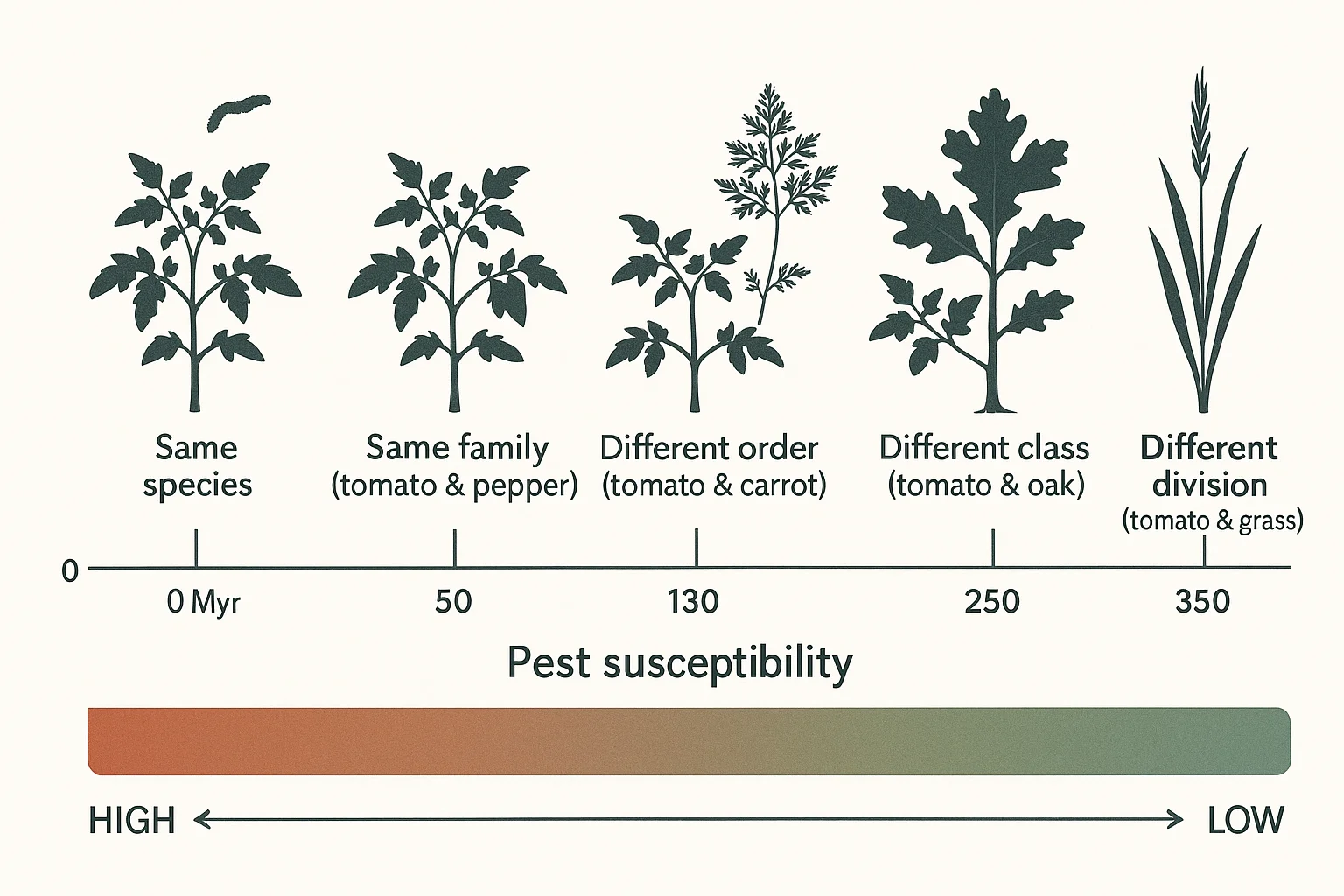
Every step further apart on the family tree adds protection. Tomato and pepper are cousins (≈20 million years apart). Tomato and carrot are distant relatives (≈110 million years). Tomato and grass barely know each other (≈150 million years) — at that distance, specialist host jumps become much less likely.
B — The Productivity Dividend
In 2025, a landmark study in Nature combined 452 experiments from around the world and found something that goes well beyond pest defence: plant mixtures with higher evolutionary diversity are genuinely more productive — they grow more together than they would apart.
+15%
more growth
Mixtures vs. single species
averaged across 452 experiments
⅔
from cooperation
Plants helping each other
not one species dominating
✓
PD adds its own boost
Even after accounting for
other diversity measures
Chen et al. 2025
Why does evolutionary distance predict cooperation? Because plants from deeply divergent lineages tend to differ in the high-dimensional diversity of their functional characteristics — niche partitioning that reduces direct competition. Chen et al. found that leaf nitrogen content was a key trait, and that facilitation by nitrogen-fixing plants was especially important.
Evolutionary distance captures something trait databases miss. Even when researchers accounted for species richness, nitrogen-fixer presence, and biomass inequality, PD still added predictive power on its own. It reflects niche differences — in functional traits, biotic feedback, and resource partitioning — that aren't fully captured by simpler measures.
The single biggest cooperation boost came from including a nitrogen-fixer (like a bean or clover): mixtures with an N-fixer showed significantly stronger complementarity effects than those without. PD helps here too — legumes sit far from most other plant families on the tree of life.
C — The Underground Connection
Evolutionary diversity also shapes what happens underground. A 2024 study in subtropical forest found that when the trees above ground were more evolutionarily diverse, the soil fungi below them were more diverse too — and those fungi were better equipped to recycle nutrients.
Fungi ✓
more diverse trees = more diverse fungi
Statistically significant
bacteria: no effect
60%
of soil function explained
By the full model
tree diversity was a key driver
Fang et al. 2024
The mechanism works through three steps: diverse trees drop different kinds of leaf litter, which feeds a wider range of soil nutrients, which supports more types of keystone fungi, which builds a more stable underground network. The end result is a richer gene pool for cycling carbon, nitrogen, and phosphorus — the biological machinery that makes soil fertile.
There's a practical reason this works: different plant groups partner with different types of soil fungi. Many forest trees work with one fungal type (ectomycorrhizal), while most herbs and grasses work with a completely different one (arbuscular mycorrhizal). A guild that mixes trees, herbs, and grasses is more likely to support both fungal types — giving the soil a more complete workforce.
Early evidence — we're honest about that. This comes from one study in subtropical forest. The logic is sound and the effect was strong, but it hasn't been replicated widely yet. We treat this as a promising finding, not a settled fact.
D — The Structural Ripple
Grasses, shrubs, and trees don't end up in different parts of the family tree by accident — growth form tends to run in families. That means a guild with high evolutionary diversity is more likely to include a mix of shapes and sizes: ground-cover herbs, mid-height shrubs, tall canopy trees. This physical variety — different heights, different root depths, different canopy shapes — creates structural complexity.
The chain works like this: more evolutionary diversity leads to more growth form variety, which creates a more physically complex garden, which in turn supports better productivity, more stable microclimates, and more habitat for pest-eating predators.
A 2023 review of 29 studies found that plant diversity increased structural complexity in 93% of cases, with diverse plantings averaging roughly twice the structural complexity of low-diversity sites (Coverdale & Davies 2023).
Correlated, not identical. We score structural diversity as a separate metric. A guild can have high evolutionary diversity with low structural variety (all trees, but from different families) or low evolutionary diversity with high structural variety (one family that includes a tree, a shrub, and a ground-cover). The link is real but not automatic — that's why we measure both.
E — The Baseline: What Species Variety Already Does
Evolutionary distance makes all of these stronger — but even just mixing different species, without worrying about how related they are, already gives your garden real protection. A major 2012 review identified eight distinct mechanisms through which species variety suppresses pests and disease (Ratnadass et al. 2012).
Specialist host blindness
A pest that evolved to recognise one type of plant simply can't find a host when it's surrounded by different species. The more different, the more lost it gets. Evidence: Jactel 2021 — 624 study cases; Gilbert & Webb 2007 — 53 fungal strains.
Soil disease barriers
Soil diseases find their hosts by sensing chemical signals from roots. Mixing plant families scrambles those signals. Evidence: Chadfield 2022 — intercropping reduced nematode damage by 40% and soil disease by 55%.
Aromatic confusion
Different species produce very different scents. In a mixed planting, the air carries a cocktail of aromas that confuses pests trying to sniff out their host. Some neighbours even trigger defensive scent production in nearby crops. Evidence: Ninkovic 2013 — onion proximity triggered potato to release significantly more of two aphid-deterrent terpenoids.
Visual confusion
Specialist insects land on any green surface and taste it to check if it's the right plant. In a mixed garden, most landings are on the wrong plant — the insect takes off without feeding or laying eggs. Evidence: Risch 1983 — 59% of 198 specialists showed fewer attacks; Finch & Collier 2000 — for the cabbage root fly, egg-laying dropped about 5-fold in mixed plantings.
Natural enemy shelter
More types of plants means more types of beneficial insects — ladybirds, hoverflies, parasitic wasps, spiders. It's the variety of pest-eaters, not just the number, that keeps pests in check. Evidence: Dainese 2019 — 89 studies, 1,475 sites; about half of the negative effect of landscape simplification on pest control was mediated by the loss of natural enemy richness.
Root chemistry and soil defence
Different plant families protect the soil in different ways: garlic and onions release sulphur compounds during decomposition that kill nematodes, marigolds release root chemicals toxic to soil pests, and legumes suppress parasitic weeds underground. Evidence: Ratnadass 2012.
Crop rotation
Soil pests build up when the same type of plant grows season after season. Rotating to an unrelated crop starves them — they can't feed on the new plant and their numbers collapse. Evidence: Ratnadass 2012.
Better-fed plants fight harder
Companion plants from different families contribute to more balanced soil fertility. Better-nourished crops mount stronger defences against pests and pathogens. Evidence: Ratnadass 2012.
How We Measure It
We track phylogenetic diversity in two complementary ways. Faith's Phylogenetic Diversity (Faith's PD) adds up the unique evolutionary history in your guild. Mean Pairwise Distance (MPD) measures the average evolutionary distance between every pair of plants. Both are measured in millions of years; the guild score is based on MPD, and we display Faith's PD alongside it for context.
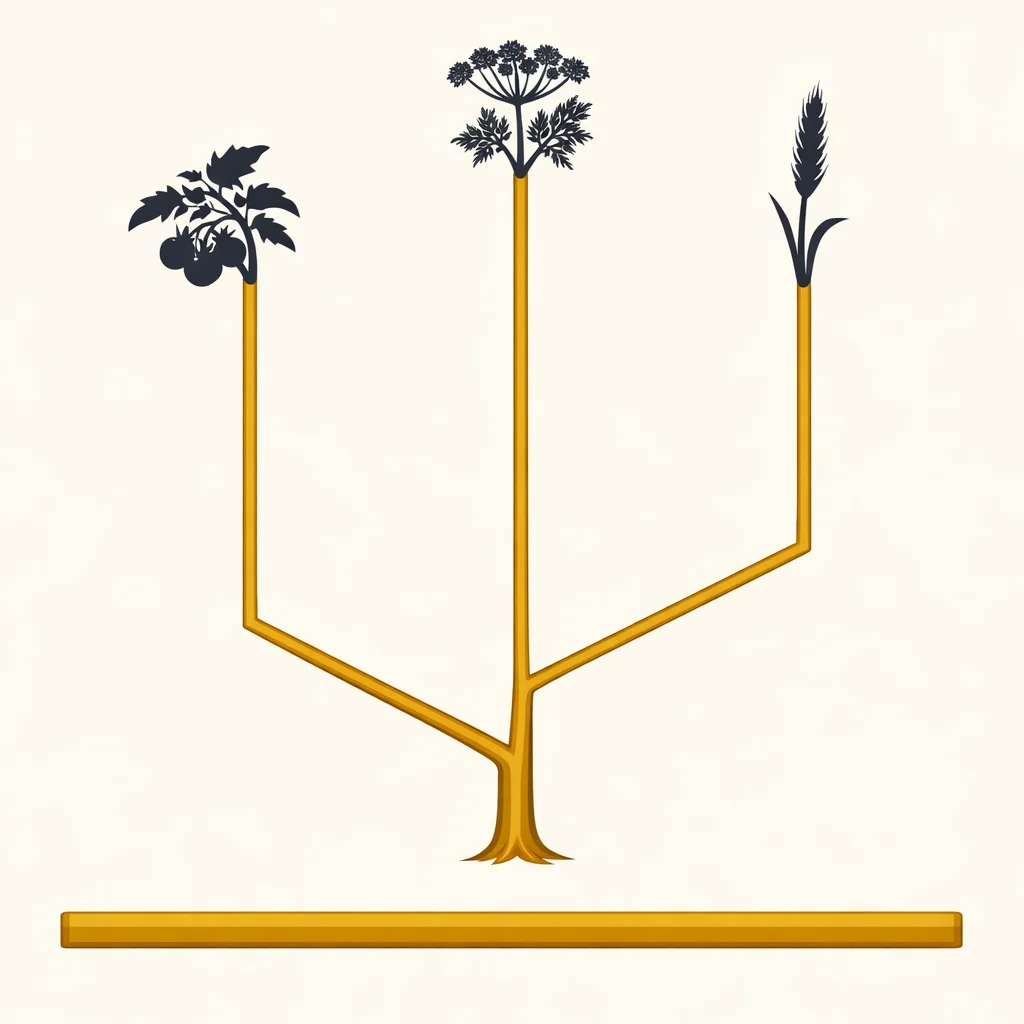
Build the tree
We generated a phylogenetic tree of 39,000+ plant species using VPhyloMaker2 — building on a time-calibrated vascular plant backbone phylogeny. Every branch length is in millions of years (Myr).
Find your plants on it
Each plant in your guild is matched to its position on the tree.
Measure every pair
For each pair of plants in your guild, we measure how far apart they sit on the tree — in millions of years of independent evolution. We then average across all pairs to get the guild's mean pairwise distance (MPD).
Turn it into a score
We rank your guild's MPD against a climate-stratified reference set of 20,000 random guilds of the same size. Your percentile rank becomes the 0–100 score. We also display Faith's PD and the Gilbert probability — the chance that two randomly chosen plants in your guild share a pathogen (Gilbert & Webb 2007) — for reference.
What PD Doesn't Do
The Research Behind It
This is not one study. It is a converging body of evidence from hundreds of experiments across multiple continents and decades:
Disease rate dropped from 66.7% to 29.9% as plants became more distantly related — more than a halving of disease risk, achieved simply by mixing plant families.
Across 624 study cases from 69 papers, specialist insect damage fell as neighbouring trees became less related. For generalist insects, the overall effect was not significant.
Across 452 global experiments, complementarity effects increased with phylogenetic diversity. Evolutionary diversity captures niche differences that trait-only summaries miss.
How Guilds Are Built
See how phylogenetic distance combines with four other metrics to build a complete guild recommendation.